Pre-Series A founders and anyone who knows a startup worth funding, this is your reminder. Nominations for Startup Battlefield 200 are open, and the strongest contenders are already stepping forward. If your startup was nominated, don’t stop there. Submit your application today.
This is not just another pitch opportunity. You are stepping onto the main stage in front of 10,000+ attendees, top-tier VCs, and the global TechCrunch audience at TechCrunch Disrupt 2026. You are competing, getting live feedback from top VCs, and proving your company belongs.
If you have been thinking about applying or nominating a startup, waiting is the fastest way to miss out. Founders who move early gain the edge with more time to prepare, more visibility, and a stronger shot at standing out to the TechCrunch editorial team. Make your nomination and finish the submission by applying.
Which startups should apply?
We’re looking for early-stage startups building ambitious, innovative, and potentially category-defining products. We accept applications globally, across all industries. Most selected companies are pre-Series A, with some Series A considered on a case-by-case basis. A functional minimum viable product (MVP) and a clear product demo are required. Above all, we back strong founders and ideas with real impact.
This is the same stage where companies like Dropbox, Discord, Fitbit, Trello, and Mint made their early mark. See who else has made it big through Battlefield 200.
Each year, thousands apply. 200 are selected to participate. 20 reach the final round to pitch live on the Disrupt Stage. Only one champion wins. Learn more and apply here.
What selected startups get
– Global exposure across TechCrunch’s audience
– Free exhibit table for all 3 days
– 4 all-access Disrupt passes
– Featured startup profile in the event app
– Press list access and lead generation opportunities
– Exclusive founder masterclasses
– A chance to pitch live on the Disrupt Stage
– Direct feedback from top VCs
– A shot at $100,000 in equity-free funding
Apply for Startup Battlefield 200 today
Applications close May 27, but the founders who win do not wait. They move early and take their shot before the competition catches up.
This Week Only: Up to $482 savings for Disrupt 2026
Offer ends April 10, 11:59 p.m. PT
Your next round. Your next hire. Your next breakout opportunity. Find it at TechCrunch Disrupt 2026, where 10,000+ founders, investors, and tech leaders gather for three days of 250+ tactical sessions, powerful introductions, and market-defining innovation. Register now to secure these savings.
This Week Only: Up to $482 savings for Disrupt 2026
Offer ends April 10, 11:59 p.m. PT
Your next round. Your next hire. Your next breakout opportunity. Find it at TechCrunch Disrupt 2026, where 10,000+ founders, investors, and tech leaders gather for three days of 250+ tactical sessions, powerful introductions, and market-defining innovation. Register now to secure these savings.
If you are building something that could define a category, or know a founder who is, this is your moment. Nominate your startup or one that belongs in the arena. If nominated, submit your application. Don’t sit on the sidelines and miss your shot.
Author: TechGeeks
-
Startup Battlefield 200 applications open until May 27 | TechCrunch
-
Laser chips promise faster, greener indoor wireless at gigabit speeds
Indoor wireless is hitting limits as more devices crowd the same spectrum. Streaming, video calls, and smart home gear are pushing networks harder while power use rises. A new class of laser chips offers a different path by moving data onto light.
Researchers built a chip-scale optical link that delivers ultra-fast indoor connections with lower energy use. Instead of broadcasting signals widely, it sends data through controlled infrared beams, opening more usable capacity while avoiding interference in dense spaces.
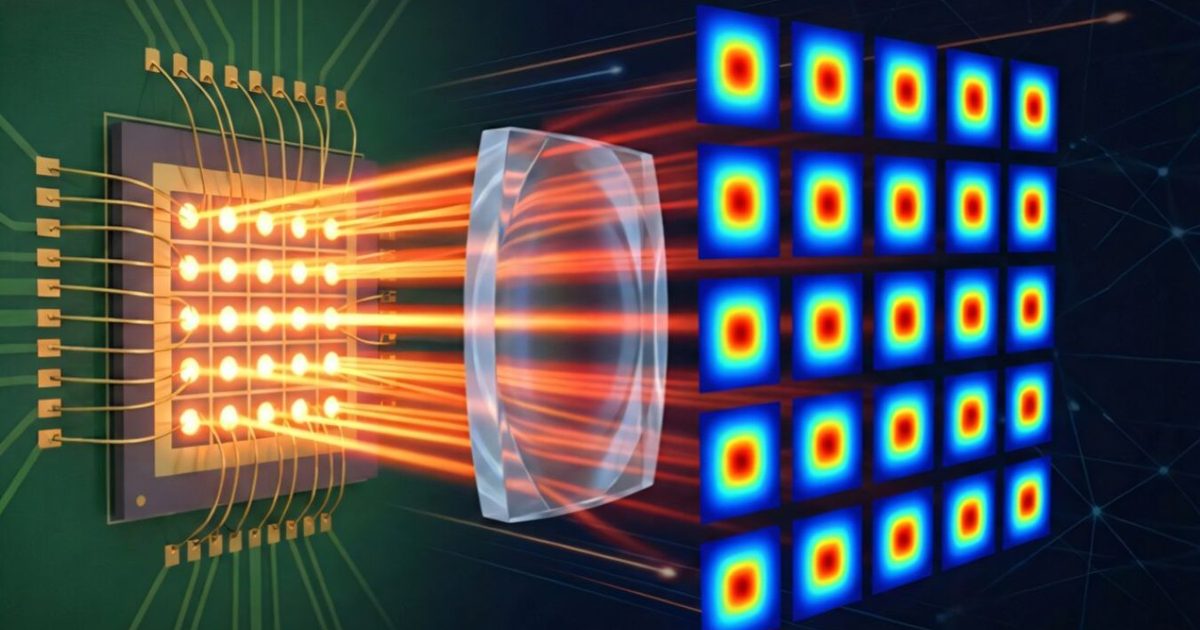
At the core is a chip with 25 microscopic lasers, each carrying its own stream. Working in parallel, they push throughput far beyond a single source. In testing, the setup reached more than 360 gigabits per second across a short indoor link.
The gains are not just speed. Power use drops significantly, offering a more efficient way to handle rising demand.
Laser array proves the speed
Performance comes from a 5 by 5 array of vertical-cavity surface-emitting lasers, each acting as its own high-speed channel.
In tests over two meters, individual lasers delivered about 13 to 19 gigabits per second. With 21 active channels, total throughput reached 362.7 gigabits per second, among the fastest chip-scale optical results so far.
The limit came from the receiver hardware, not the transmitter, suggesting higher speeds are possible with better components.
A custom optical setup also shapes each beam into a defined square, limiting overlap so multiple links can run side by side without interference.
Why light changes the equation
Radio networks struggle in crowded spaces where signals interfere and capacity gets stretched. Light avoids those limits by offering more bandwidth and precise control over where signals go.
Instead of blanketing a room, the system creates a grid of targeted beams with minimal spillover. Measurements show uniform coverage across the target area, helping maintain stable performance for multiple devices.
The setup runs at about 1.4 nanojoules per bit, roughly half that of comparable Wi-Fi systems. The tradeoff is range, as the current setup works over short distances and depends on line of sight.
Where this goes next
This approach is meant to complement existing networks by offloading heavy traffic in high-demand indoor spaces.
The hardware fits on a sub-millimeter chip built with standard processes, making integration into fixtures or access points plausible, though no commercial timeline is given.
As demand rises, combining radio and light-based links could become standard, with laser systems handling the heaviest traffic.