Have you ever wanted to know how well your friend slept last night? Not just by their own word of mouth, but with the receipt to prove it? Now you can with Circles, a new feature Oura announced Thursday for its app that lets you share different health data with up to 10 “circles” of people.
Circles will share Readiness, Sleep and Activity with people you allow in your circle — up to 20 per circle. You’ll be able to choose which kind of data you share with each group, so one circle can get more of your wellness information than another.
The three scores are summaries of the health data the ring collects, including temperature, heart rate and blood oxygen readings. Oura said it plans on expanding the type of information able to be shared in the future.
To start a circle, open the Oura app, scroll down the main menu and select “Circles.” Then you can name a circle, decide what scores you want to share and also decide whether you want that data to be daily or weekly averages. To invite people into the circle (they have to be fellow Oura users), you’ll send them a one-time link.
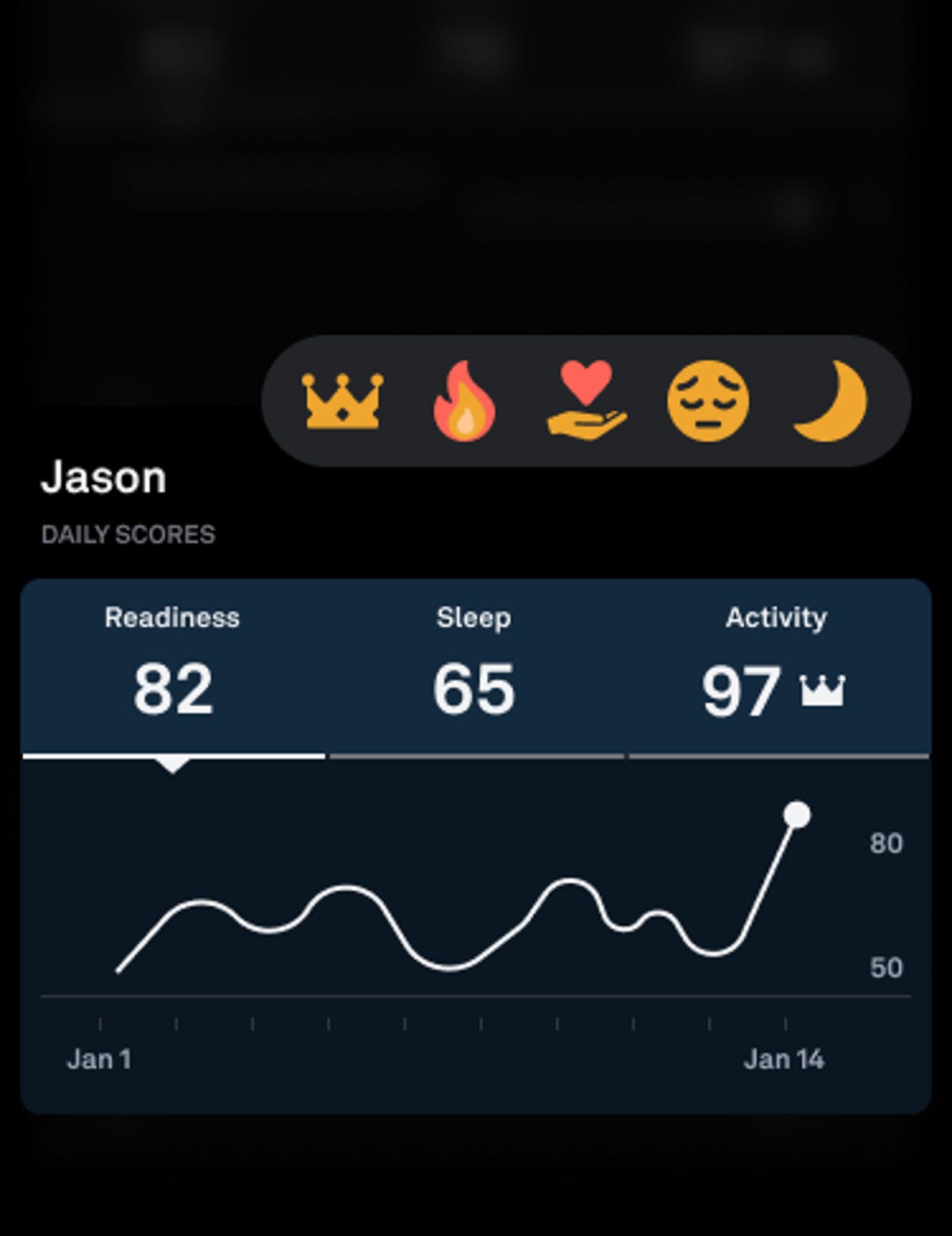
Once you’ve started your circle, you can view their scores and “react” with emojis, if you choose. Everyone has to sync their rings to keep the scores visible.
What it looks like to react to your friend in Circles.
Oura
For people who enjoy collecting health data (and maybe boasting about a good health week), Oura’s Circles features is a good way to do that with other Oura wearers. According to a press release, though, the company is positioning Circles as another way to check in and connect with each other, which is becoming an increasingly important public health goal amid a loneliness epidemic, which has impacts on sleep, mental health and physical illness.
“Our mission at ŌURA has always been to improve the lives of our members by taking a compassionate approach to health, and this new feature is just the next step in delivering a personalized experience that allows our members to connect with not only their bodies, but also their friends and family,” Oura CEO Tom Hale said in a statement.
Oura’s Circles announcements comes as the company is advancing its sleep staging algorithm out of beta mode, which means everyone tracking sleep stages with Oura will get data from the new algorithm, which Shyamal Patel, the company’s head of science, calls “massive improvements of accuracy” in sleep data. The new algorithm has 79% agreement with polysomnography sleep tests done in a clinic, Patel told CNET.
Compared to Oura’s older sleep-tracking algorithm, ring wearers might experience slight changes in the amount of time Oura tells you you’re spending in deep sleep versus light sleep versus REM sleep.
“Those numbers are likely to shift a little bit,” Patel said.
The Sony WF-1000XM5 are among the most anticipated new wireless earbuds of 2023. They’re the successor to the XM4, which earned a CNET Editors’ Choice award when they were released in 2021 (and not to be confused with the WH-1000XM5 full-size headphones). Back in March, the Walkman Blog uncovered an image of the new buds in their preproduction state as they made their way through the Federal Communications Commission’s certification process. Now, the Walkman Blog has shared additional info and images, with WinFuture posting what appear to be images of the final product. A release seems imminent.
According to the Walkman Blog’s report, the XM5 are smaller than the XM4 and are shaped differently, which may help them fit more ears comfortably (the XM4 could be a little big for some ears). Leaks reveal that each bud will weigh 5.9 grams, or 1.4 grams less than the XM4 buds. The case for the XM5s is said to be two grams lighter.
The buds are equipped with Bluetooth 5.3 with multipoint pairing and should support Bluetooth LE Audio, according to the Walkman Blog. Bluetooth LE Audio supports such features as Auracast (broadcast audio) and the LC3 audio codec.
The XM4 have a matte finish, but the XM5 appear to have a mostly glossy finish, although the touch surface on the outer face of the bud seems to be matte. Many people aren’t fans of glossy finishes as they tend to be fingerprint magnets.
Enlarge Image
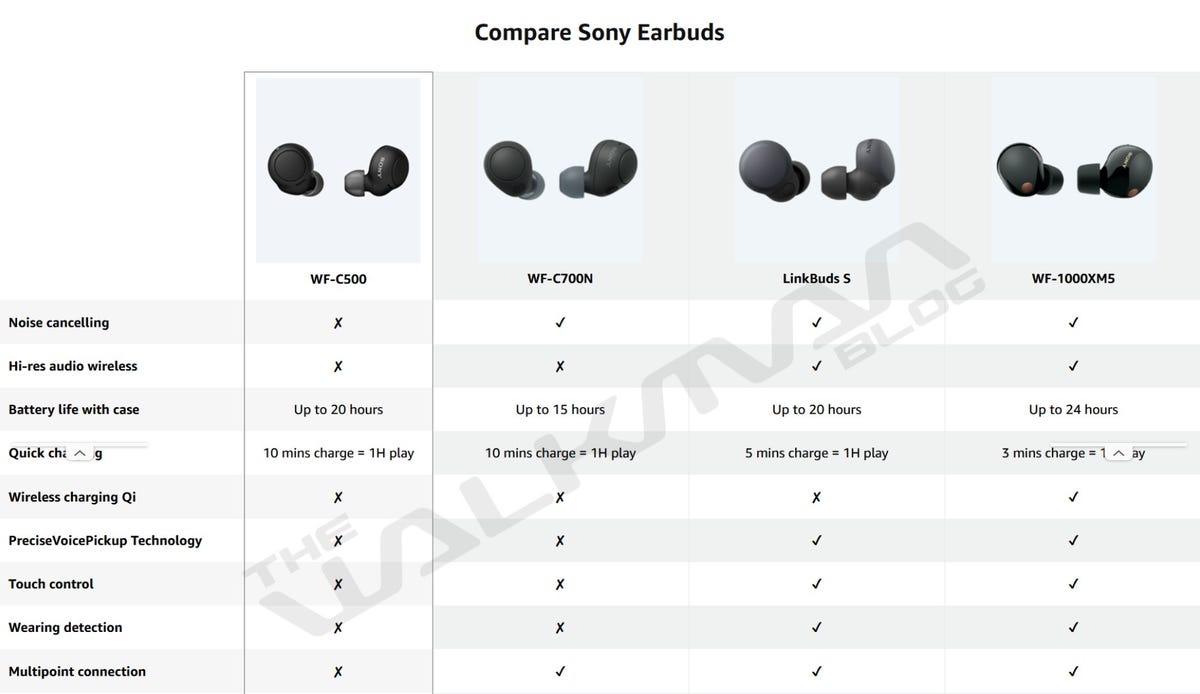
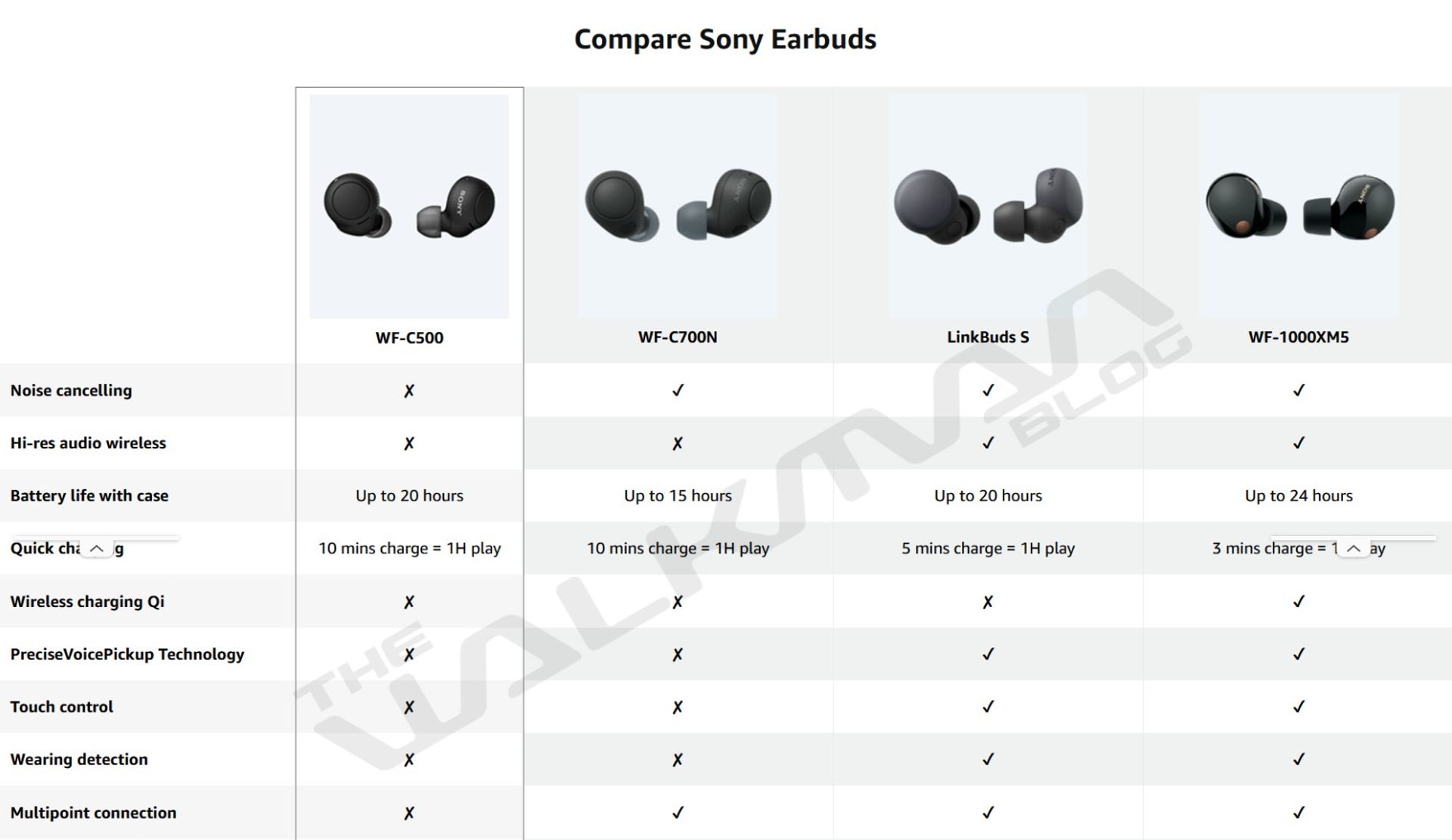
Some leaked comparison specs that also include a reference to the Sony WF-700CN, a new entry-level model.
Walkman Blog
The XM4 carries a list price of $280, but if the WF-1000XM5 follows the same path as the full-size WH-10000XM5, we could very well see a price hike to $300 or more.
The XM4 earbuds were released on June 8, 2021, so a lot of folks, including me, have been expecting the XM5 to be announced this month. Typically, Sony updates its flagship headphones every two years.
Separately, reports — and that leaked image above — suggest Sony will also soon unveil the WF-700CN earbuds, but that’s a more entry-level model.
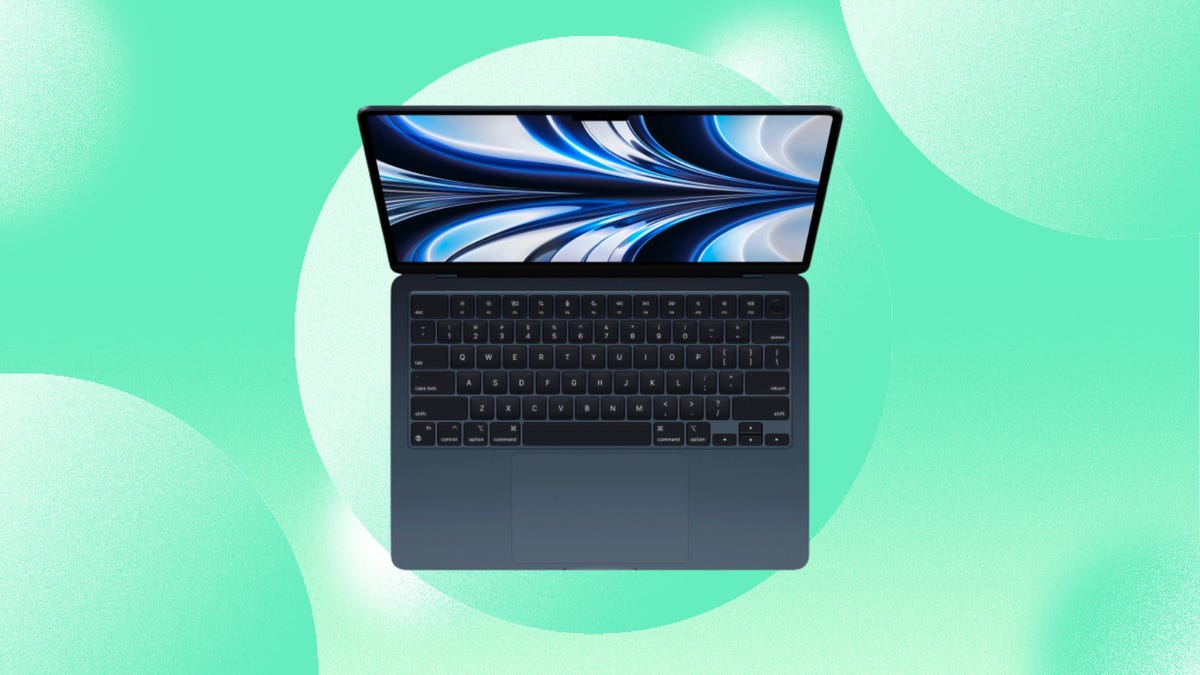
Apple’s popular MacBook Air received one of its biggest redesigns ever last year, and CNET quickly named it the best laptop for most people. Despite being among Apple’s newest Macs, we’ve already seen several solid MacBook Air M2 deals and B&H has slashed the price on the entry-level model down to a new low of $999, saving you $200 on the 256GB configuration. With the recently unveiled 15-inch model‘s imminent release, the MacBook Air M2 saw an official price drop of $100 — and this deal save an additional $100 on top of that. This offer is available now through Saturday, June 10.
The MacBook Air M2 features a larger and brighter 13.6-inch Liquid Retina Display and thinner overall profile than previous models. Inside, it’s powered by Apple’s M2 chip, which allows for a performance bump of up to 40% and battery life as long as 18 hours, according to Apple. Other notable improvements include a 1080p FaceTime camera, a four-speaker sound system with support for Spatial Audio and support for Apple’s helpful MagSafe charging cable. The base model on sale at B&H features a 256GB SSD, M2 chip with an eight-core GPU and 8GB of RAM. This deal is available on the silver, space gray and midnight color variants.
And be sure to check out our roundups of deals on MacBooks and laptops if you want to see other models that are currently on sale.
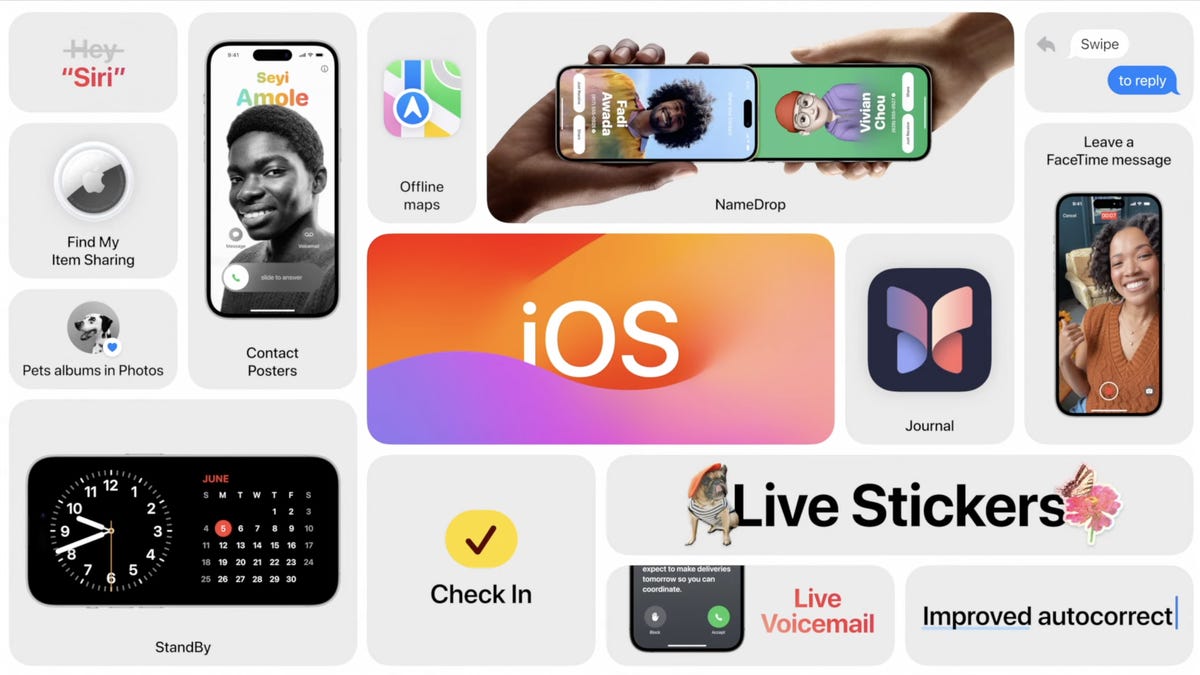
New features are coming to Apple’s Messages thanks to the iOS 17 software update the company announced Monday. With iOS 17, you’ll be able to turn pictures into stickers, transcribe voice memos, keep your friends and family notified on your way home, and more.
News about the iOS 17 Messages update came during the keynote address at the Worldwide Developers Conference at the company’s headquarters in Cupertino, California. Apple traditionally uses the annual event to give developers a preview of updates to its desktop and mobile software, and sometimes it introduces new hardware too. On Monday, the company unveiled its first mixed reality headset, the Vision Pro.
The update to Messages will be part of iOS 17, which will arrive this fall. With the new features, people will be able to take their photos and turn them into stickers they use in text conversations, alongside standard emoji, which can also be used as stickers. People can customize their stickers with effects — like shiny, puffy, comic and outline — and keep them in a new drawer in the keyboard for streamlined access, Apple said in a press release. Stickers will be available systemwide, including in third-party apps.
To make a photo into a sticker, you’ll touch and hold an object in a photo. Then you can style your object with various effects, outline it or create animated Live Stickers with Live Photos. To use the sticker in Messages, you’ll add them in the bubble from the Tapback menu.
Watch this: Apple Reveals iOS 17
16:43
Search in Messages, Check In and more
Also coming is a refined search feature. People will be able to apply additional filters to their Messages search to more quickly find the exact conversation they’re looking for. Plus, when you’ve received lots of texts in a group chat, you’ll be able to use the catch-up arrow to locate where the conversation left off last.
iOS 17 Messages will also transcribe voice memos you receive, if you don’t have the time to listen to them. Apple also announced a new feature that will let you keep track of your friends by viewing their location in your text conversation.
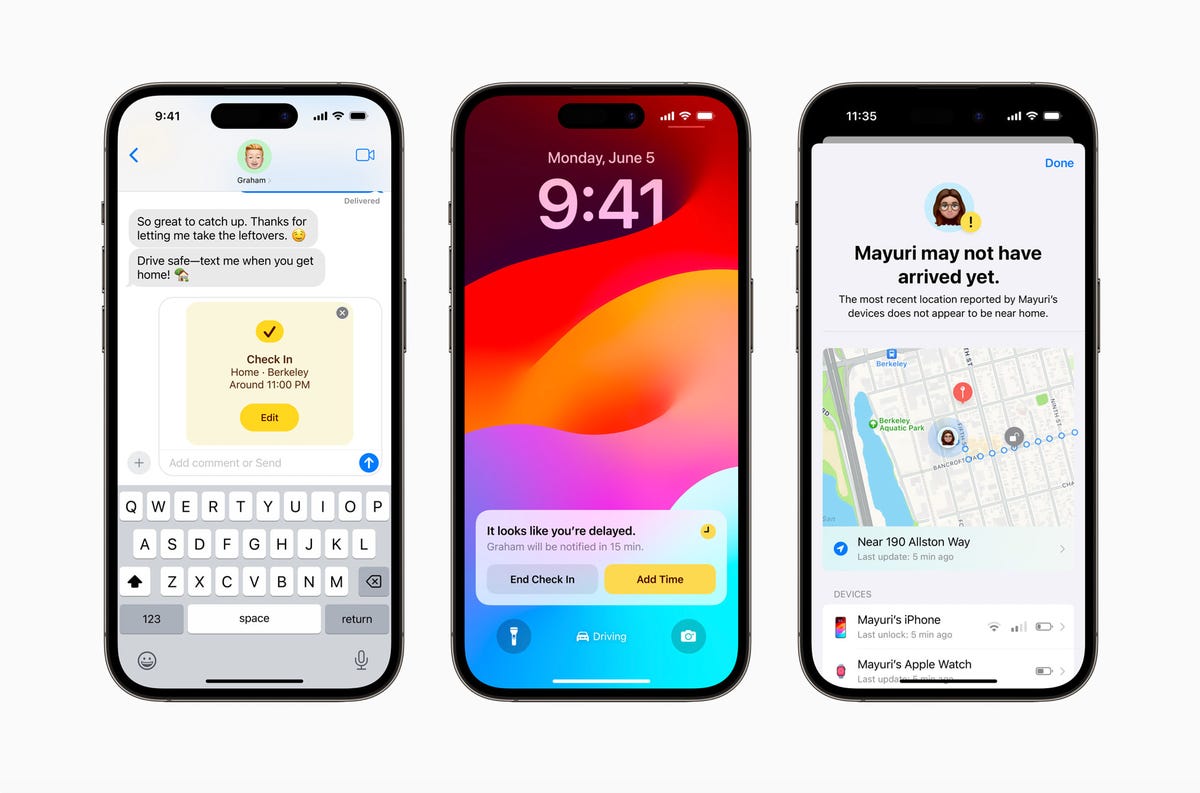
Apple’s Check In feature through iOS 17.
Screenshot by CNET
Another new location sharing feature is Check In. If you want to keep a friend or family member updated on your journey home, for example, you’ll be able to use Check In, which notifies the person of your whereabouts and lets them know if you’re having trouble getting home. “If they are not making progress toward their destination, useful information will be temporarily shared with the selected contact, such as the device’s location, battery level, and cell service status,” Apple said in the press release. Check In will be end-to-end encrypted, so only you and the person you’re sharing this information with is privy to your location.
The iOS 17 updates don’t stop at Messages. Apple also introduced Live Voicemail, which will give people the ability to see the message a person is leaving you as it is being recorded. This could help with deciphering between important calls that unknown numbers leave and spam.
The iOS 17 update for FaceTime includes audio and video messages, so people can leave their friends and families a FaceTime voicemail of sorts.
Also, if people want to share a contact with one another, they can use the new feature NameDrop. By bringing two iPhones or one iPhone and one Apple Watch close together, contact information can be transferred from one device to the next.
There are a dozen different streaming services to choose from and the monthly costs can soon add up even if you only subscribe to a handful of them. It’s a good idea to take advantage of any savings when you can to keep your streaming costs down, and right now, you can take 60% off the cost of your first year of NBC’s Peacock Premium. All you have to do to score the savings is use code SUMMEROFPEACOCK during checkout, saving you $30 and dropping the equivalent monthly cost down to $1.67. The promotion ends on Monday, June 12, so you don’t have long left to get in on it.
It’s important to note that, while Peacock offers two different membership plans, this offer is designed for the standard Peacock Premium subscription, which does include some ads. You can use the code when choosing the ad-free Premium Plus membership, though you’ll save the same $30 flat amount rather than getting a 60% overall saving. Either way, you’ll get access to the entire library of shows, films and Peacock originals, as well as select live sports. You can also watch any current NBC and Bravo shows, and you’ll get access to over 50 always-on channels.
You can also check out our full roundup of all the best streaming service deals out there for even more ways to save.
Apple on Monday unveiled a new product in its Mac lineup: a 15-inch MacBook Air. And though we’re only a few days out from Apple’s WWDC keynote presentation, and 15-inch MacBook Air preorders are still open ahead of the machine shipping next week, you can already save on Apple’s newest laptop. Over at Amazon, you can preorder the new machines with a near-$50 discount. That drops the starting price down to $1,250 for all four available colors in the 256GB capacity, and you can upgrade to the 512GB model while saving the same amount.
This is the first direct dollar discount we’ve seen on the 15-inch MacBook Air and it represents a rare chance to save on a pre-release Apple product. Amazon isn’t listing an end date to this sale, so it’s worth locking in the reduced price while you can if you’re in the market for a laptop upgrade. The next best deal on the 15-inch MacBook Air is at Best Buy where a $50 gift card is being included with preorders, though that’s only for Totaltech members.
Apple’s 15-inch MacBook Air is the largest Air model to date and offers an attractive option for those wanting a big screen Mac portable without spending over the odds on a MacBook Pro. It’s essentially the same as the 13-inch MacBook Air but with a larger, 15.3-inch display. It features the same M2 chip, Touch ID sensor, two USB-C/Thunderbolt ports, MagSafe charger and 18-hour battery life. Its screen supports up to 500 nits of brightness and up to a billion colors. And there’s a built-in 1080p camera for FaceTime calls, too, as well as a three-mic array and six speakers for spatial audio support.
Despite offering a larger display, the 15-inch MacBook Air still feels thin and light, as CNET’s Dan Ackerman found in his hands-on time with the device, weighing in at just over 3 pounds and measuring 1.15cm thin.
Adobe has brought its Firefly tools for generative AI to its Adobe Express app for quickly generating posters, videos, fliers and other graphical material. The first two new AI tools that let you add images and text effects generated from a text prompt, Adobe said Thursday.
AdobeExpress is what the company calls an “all-in-one content creation app.” Adobe released thefeatures in a new beta version of the web version of Adobe Express andplans to match them with an updated mobile app in two to three months,said Govind Balakrishnan, senior vice president of Adobe’s CreativeCloud subscription service.
Generative AI has captured the public imagination with the ability to produce song lyrics, essay question answers and countless other tasks. AI is trained to spot patterns in enormous sets of training data, but it can spout plausible sounding but completely wrong information. So be warned if you’re looking for tax advice or medical help.
Adobe’s generative AI tools, like a beta version of Photoshop in testing now, are arguably a more natural fit since many people using it will be looking for flights of fancy like colorful flowers or letters that look like they’re overgrown with ivy.
The new version of Adobe Express also gets video editing abilities, potentially handy for the TikTok or Instagram Reels crowd, and the ability to import, edit, and export PDF files.
Adobe Express is free in basic form but costs $10 per month for people who want more templates, photos, videos and fonts. When the AI tools exit beta testing, they’ll come with a free level of generated images — the threshold hasn’t yet been determined — and some pricing tiers for more.
“We will obviously have to put some sort of a limit on the number of generations,” Balakrishnan said. “These are expensive.”
Expensive it may be, but it’s also potentially very interesting to the creative set that already spends a lot of time coming up with new imagery.
“We continue to view generative AI as a tailwind for Adobe,” RBC Capital Markets analyst Matthew Swanson said in a Wednesday report.
Wing, the drone delivery subsidiary from Google parent company Alphabet, has shown publicly for the first time the “autoloader” station it expects will make it significantly easier for retailers to send products through the air to customers.
The autoloader, announced in March and set to be deployed later this year, is a Y-shaped stand that easily fits in a parking space. A company employee hangs a delivery box on a pair of hooks on the autoloader then returns to work. There’s no need to wait for the drone to arrive, because it can snag the package on its own by lowering a yellow hook to the autoloader station.
Adding the autoloader may seem like a minor change, but it paves the way for a potentially massive expansion of drone delivery. Instead of operating isolated base stations, Wing envisions a fleet of drones autonomously dispatched across a network of delivery and charging stations, hopping from one destination to another with a minimum of human intervention. Inexpensive autoloaders make it easier to bring new retailers into the network.
Drone delivery today remains limited by regulators who limit its expansion to a few pockets, but the regulations are maturing along with the technology. Expect millions of us to be within drone delivery range this year from Wing and rival drone delivery efforts from Zipline, Amazon, Drone Express, Matternet, DroneUp, Manna and others.
Wing demonstrated its autoloader technology in a company parking lot at offices in Palo Alto, California, flying packages to a nearby courtyard. It took no special measures to avoid people, trees and cars other than blocking off three parking spots with traffic cones, a sign that Chief Executive Adam Woodworth said shows how mature operations have become.
“We are at the point in this journey where I think that this is a thing that’s going to happen,” Woodworth said. Wing has made more than 340,000 drone deliveries so far with operations in Australia, Finland, Virginia and Texas.
The autoloader has no computer controls or moving parts, but it’s still pretty sophisticated. The two upward pointing poles help guide the drone’s hook, dangling from a string below the hovering drone, to a narrow slot that aligns the hook properly to latch onto the waterproof, recyclable package.
The slot, package and drone hook are all designed to work together. For example, the hook will grab the package only once it’s pushed through the hole on the package. Its round bottom won’t bump back in to regrab it after release.
“It’ll save a lot of time for the user. Instead of going to the store and picking something up, you’re staying at home and waiting for the drone to deliver it to your doorstep,” said Wing marketing chief Jonathan Bass. “For a worker, they can essentially place the package on the auto letter, go back inside and continue working. We think it will save a lot of time.”
The drones, made chiefly of foam, weigh 11 pounds each and can carry a payload up to 3.3 pounds.
“We do expect to introduce aircraft that can deliver larger payloads and some smaller [aircraft] that might be longer range,” Bass said.
Today, Wing’s drones have a range of 6 miles, though bing part of a Wing delivery network, with a mesh of destinations, will extend that since Wing can offer wireless charging pads in more locations.
Will we someday see delivery drones blackening the skies? Not likely, Woodworth believes. Even with current operations launching 1,000 flights a day, which can mean one every 30 seconds or so, drones are unusual.
“The sky is really big,” Woodworth said. “Even at full scale, you’re not going to look up and see tons of airplanes.”
Apple announced its long-awaited Vision Pro mixed reality headset at its Worldwide Developers Conference on Monday, signaling its first major new product in almost a decade. The problem? You’ll have to pay $3,500 to try it.
That’s a lot (even for Apple), sparking a deluge of Twitter memes and a collective groan from the audience present at Apple’s conference.
Behind those jokes, there’s a valid point. At $3,500, Apple’s Vision Pro costs more than three weeks worth of pay for the average American, according to Bureau of Labor Statistics data. It’s also significantly more expensive than rival devices like the upcoming $500 Meta Quest 3, $550 Sony PlayStation VR 2 and even the $1,000 Meta Quest Pro.
It tops many other Apple products in terms of price too. Buying an iPhone 14 Pro Max, a 12.9-inch iPad Pro and an Apple Watch Ultra would still be cheaper than an Apple Vision Pro (although it comes fairly close.) Shipments of virtual and augmented reality headsets also plummeted in 2022, according to International Data Corporation statistics published in March, adding to the skepticism.
In an interview Tuesday with ABC News’ Good Morning America, Apple CEO Tim Cook acknowledged the headset’s price when asked if the average person would be able to afford it.
“I think people will make different choices depending upon their current financial situation,” he said.
To call Apple’s new headset expensive may be an understatement. But once you step back and look at the larger picture beyond the initial sticker shock, that eye-watering price starts to make a little sense.
Vision Pro’s price is comparable to a high-end Mac
Despite Vision Pro’s high price, it’s far from being the most expensive computer Apple sells. There’s another Apple computer that’s roughly double the price, the $6,999 Mac Pro, which just got its first major refresh since 2019 at WWDC on Monday. Apple’s modular desktop powerhouse is designed for professionals rather than everyday consumers, meaning it’s not intended for everyone.
The new Mac Pro is $6,999.
Dan Ackerman/CNET
Even the MacBook Pro can get more expensive than most may realize once you configure it with high-end specifications. Like Vision Pro, a 16-inch MacBook Pro with Apple’s M2 Max processor, 32GB of unified memory and 1TB of storage will run you $3,499.
Years of research and development are also likely reflected in Vision Pro’s price. Since it’s an entirely different type of computer compared to the Mac, iPhone or iPad, Apple had to develop new technologies such as the R1 chip, which processes data from the headset’s 12 cameras, five sensors and six microphones. Mike Rockwell, vice president of Apple’s technology development group, even said during the WWDC keynote that the company filed over 5,000 patents during Vision Pro’s development. That effort certainly shows, according to CNET’s Scott Stein, who was impressed with the headset’s fidelity, video quality and interface.
“The engineering and depth of engineering in it is mind blowing,” Cook also said during the Good Morning America interview. “You’ve got more than a 4K experience in each eye. And, of course, it doesn’t come for free. It costs something to do that. “
That said, there’s a key difference that can make Vision Pro’s price more difficult to swallow compared with the MacBook Pro or Mac Pro. Both of those products are well established and have proven their usefulness to the creative professionals willing to pay for them. Vision Pro, however, is an entirely new product category that most people aren’t familiar with yet. It has yet to prove its value, and most people outside of Apple’s campus haven’t used it — except for select press that have gotten to try it in a demo controlled by Apple.
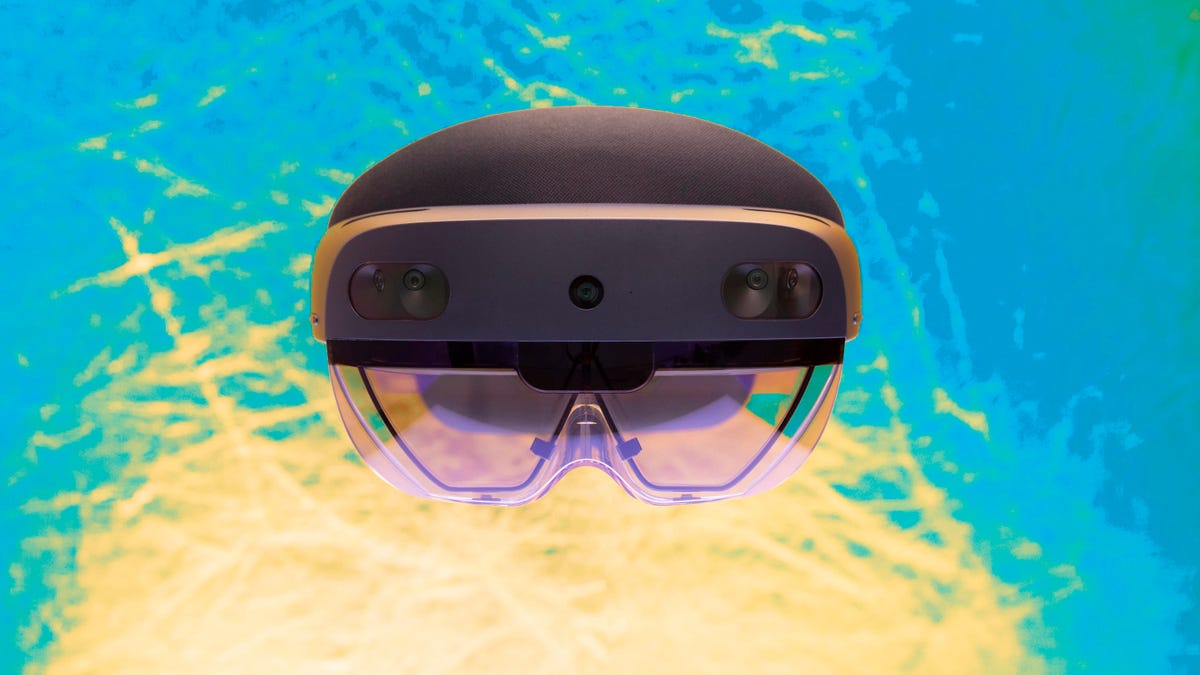
Microsoft’s HoloLens 2 is the same price as Vision Pro
Microsoft’s HoloLens 2
James Martin/CNET
Long before there was Vision Pro, there was Microsoft’s HoloLens, a head-mounted computer that also sought to change the way we work by overlaying digital graphics on top of the real world. The original HoloLens debuted in 2015 and the second version arrived in 2019 for $3,500 — the same price as Apple’s Vision Pro.
On one hand, that makes Vision Pro’s price more sensible. But there are some important differences between Apple’s new head-mounted computer and the HoloLens to consider. Take one look at Microsoft’s website for the HoloLens 2, and it’s clear the company sees this as an enterprise device more than a personal computer.
While the HoloLens may have initially been positioned as the next generation of computing, Microsoft is now primarily touting its usefulness in fields such as manufacturing, construction, health care, engineering and education. For companies and institutions, that makes purchasing a HoloLens 2 more like investing in a new piece of equipment rather than buying a new computer. Apple, however, seems to be targeting Vision Pro at everyday consumers that want a bigger canvas for working, watching movies and participating in FaceTime calls.
New tech gadgets usually get cheaper over time
Apple’s Vision Pro headset
Scott Stein/CNET
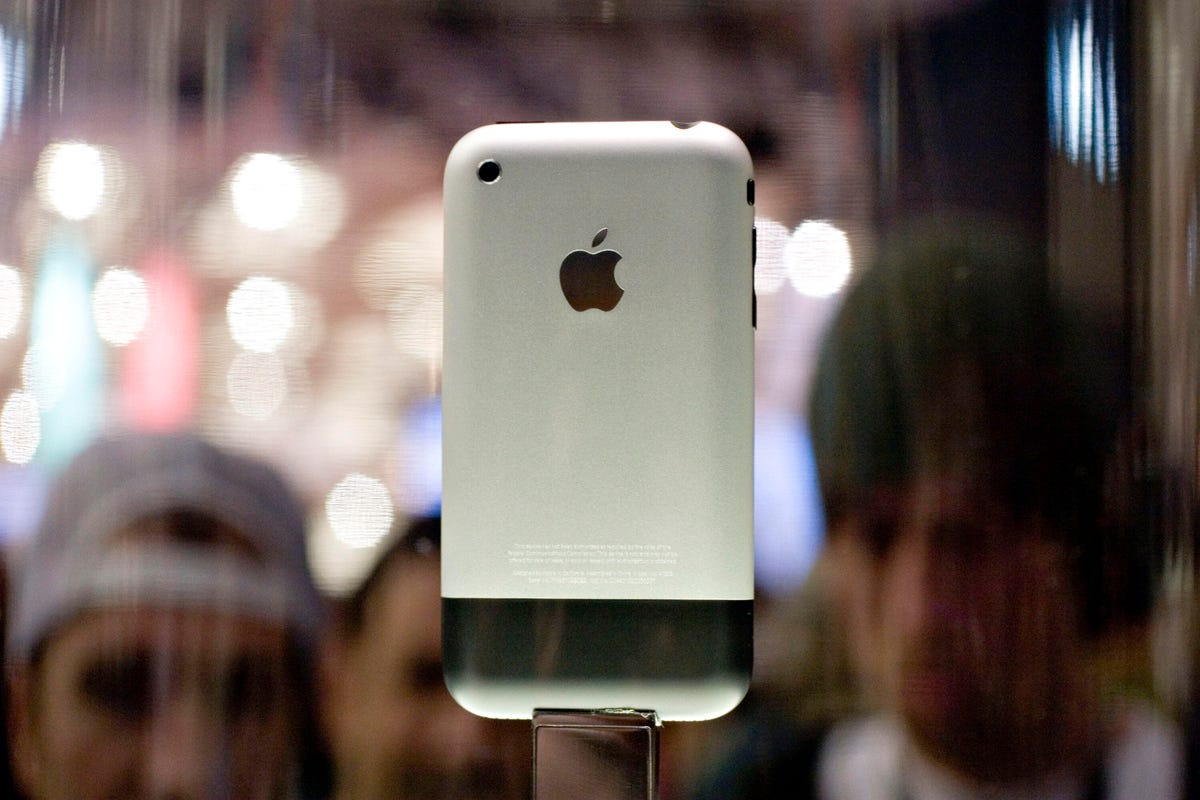
First-generation technology products are typically expensive and limited compared with their successors. When the iPhone arrived in 2007, there was only one model and it started at $500, or roughly $749 in 2023 when adjusted for inflation. It included a paltry 4GB of storage, only one camera and just 15 apps. Even though Apple’s top-of-the-line iPhone 14 Pro will still cost $1,000 or more, Apple now sells several iPhones and different price ranges.
That includes the $429 iPhone SE, which has 16 times as much storage as the entry-level first iPhone, a significantly larger 4.7-inch screen compared to the original’s 3.5-inch display, a fingerprint reader and many other technologies that weren’t widely available back in 2007. And by 2023’s standards, the iPhone SE is about $320 cheaper than what Apple charged for the first iPhone.
An original Apple iPhone on display during MacWorld in San Francisco, California, on Tuesday, Jan. 9, 2007.
Eric Slomanson/Bloomberg via Getty Images
A more direct comparison might be looking at the trajectory of virtual reality headsets. When the first Oculus Rift launched in 2016, it cost $599 and needed to be tethered to a powerful computer in order to work. But today’s Meta Quest 2 costs half the price at $300 and works wirelessly.
My point: Technology gets more affordable and more advanced over time. Don’t get me wrong, Vision Pro’s price will almost certainly prevent the current iteration of Apple’s headset from becoming as ubiquitous as the iPhone or Apple Watch.
However, that might not be the point — at least not right now. With Vision Pro, Apple is trying to establish what it believes will be the next major evolution of the personal computer. That’s a bigger goal than selling millions of units on launch day, and a shift like that doesn’t happen overnight, no matter what the price is. The version of Vision Pro that Apple launches next year likely isn’t the one that most people will buy.
WhatsApp is a messaging app with big plans. On Thursday, Meta-owned WhatsApp announced that a new feature, WhatsApp Channels, is coming to the encrypted messaging service.
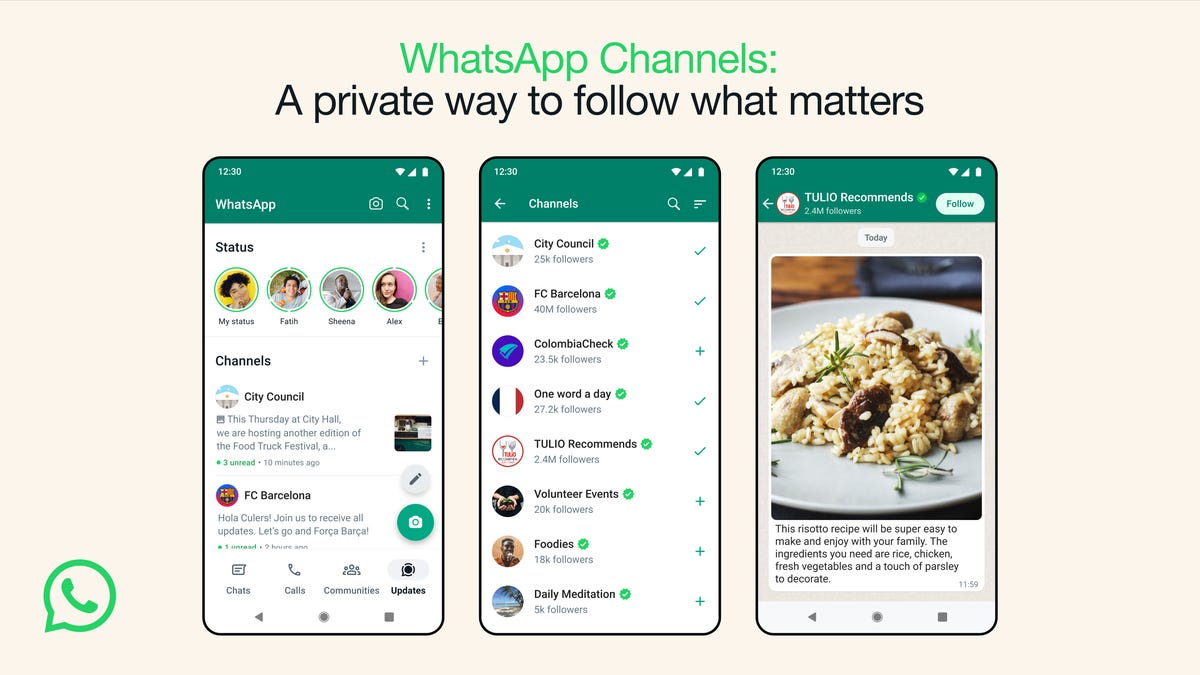
Channels is a “one-way broadcast tool for admins to send text, photos, videos, stickers and polls,” the company said in a statement. You’ll be able to use a searchable directory to select channels to follow and can choose to follow channels for your favorite sports teams, hobbies or updates from local officials.
A promotional video calls Channels “a private way to follow all topics you care about,” displaying such topics as “carpentry tips,” “traffic” and “weather.” Partners at launch will include the soccer teams FC Barcelona and Manchester City, as well as the International Rescue Committee and the World Health Organization.
A representative for WhatsApp didn’t immediately respond to a request for comment on when exactly the new feature will arrive, but the company statement says that Channels will be first available in Colombia and Singapore before arriving in other countries.
How Channels will work on WhatsApp
Channels will appear on a new tab within WhatsApp labeled Updates, separate from regular chats. Admins won’t be able to add followers to their channels, so you can’t be forced into receiving updates from any groups.
“Channels will aspire to be the most private broadcast messaging product available and will come with the strong privacy protections people expect from WhatsApp,” Meta’s statement said, noting that Channel history will only be available for 30 days, after which it will disappear automatically.
Phone numbers and profile photos of channel admins also won’t be shared with followers, and following a channel won’t reveal your phone number to the admin or to other followers.
“We also believe there is an opportunity to support admins with a way for them to build a business around their channel using our expanding payment services as well as the ability to promote certain channels in the directory to help increase awareness,” the statement said.