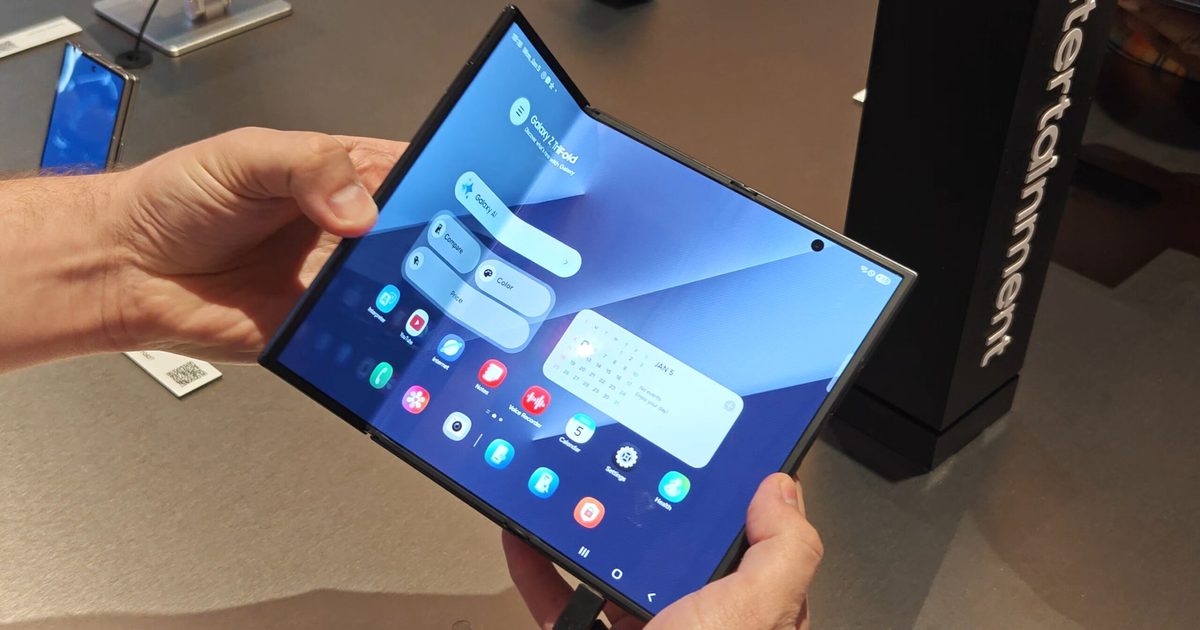
The Samsung Galaxy Z TriFold defies conventional logic, yet it exists: boasting a massive 10-inch display, dual hinges, and a premium price that may test your finances.
Samsung recognized this as a first-generation experiment, intentionally limiting production to showcase engineering prowess rather than launching a full-scale commercial release.
Yet, achieving “more successes than failures” falls short for a device priced near two or three standard smartphones. Now that the TriFold has been discontinued, attention turns to its rumored follow-up — the Galaxy Z TriFold 2, which appears to be in early development stages.
5 Critical Improvements for the Galaxy Z TriFold 2
The upcoming Galaxy Z TriFold 2 must bring meaningful changes, not just incremental updates, to justify its place in everyday carry.
Below are my candid recommendations for what the next generation must address to transform from a niche curiosity into a desirable flagship.
A Slimmer, More Robust Hinge and Frame
 John McCann / Techgeeks
The original TriFold’s dual-hinge mechanism was an engineering feat, but also its most significant compromise. At 12.9mm folded and 309 grams, it felt unwieldy compared to Samsung’s Fold 7. For reference, the Fold 7 measures 8.9 mm thick and weighs just 215 grams.
While dual hinges inherently require more space, the Fold 7 feels like a refined product, whereas the TriFold feels like a prototype. Fortunately, Samsung is already addressing this.
 Galaxy Z TriFold’s side profile John McCann / Techgeeks
 Galaxy Z Fold 7’s thickness Nirave Gondhia / Techgeeks
Recent reports indicate Samsung is designing a completely new hinge architecture for the TriFold 2, aiming for a significantly slimmer profile. However, thinness alone won’t suffice; the device must endure daily wear and tear to be a viable daily driver.
Enhanced Dust and Water Resistance
 John McCann / Techgeeks
The Galaxy Z TriFold launched with an IP48 rating, matching the Fold 7 and surpassing the Huawei Mate XT (which only had IPX8, lacking dust protection).
Yet, beating Huawei’s Mate XT isn’t a high bar, especially since the Pixel 10 Pro Fold became the first foldable to achieve a full IP68 rating, matching standard flagships.
For a device representing Samsung’s engineering peak, IP48 feels insufficient. The TriFold 2 must aim for IP68 as a minimum, just like the Fold 7 should.
Brighter Inner Display for Outdoor Visibility
 John McCann / Techgeeks
The expansive screen is the TriFold’s core selling point. It justifies the premium price for those wanting a tablet-like experience in their pocket. However, it is puzzling that the main 10-inch screen only reaches 1,600 nits, which is dimmer than the Galaxy Z Fold 5’s inner display from 2023.
To put this in perspective, the Galaxy Z Fold 7’s inner screen reaches 2,600 nits, as does the Galaxy S26 Ultra, and the TriFold’s outer screen. These numbers matter greatly when using the phone outdoors in direct sunlight.
This brightness gap determines whether you can confidently use the phone on a sunny day or must seek shade to read notifications. Given Samsung’s display expertise, I expect a brighter inner panel that rivals modern flagships and standard foldables.
Upgraded Processor for Smoother Multitasking
 Chris Hall / Techgeeks
The Galaxy Z TriFold shipped with the Snapdragon 8 Elite chip, then the most powerful mobile processor. However, thermal limitations caused it to throttle faster than other 8 Elite devices like the S25 Ultra.
While I don’t expect the TriFold 2 to eliminate thermal throttling entirely due to its thin chassis and limited cooling space, a chipset upgrade would undoubtedly enhance multitasking, gaming, and overall speed.
This year, the TriFold 2 should adopt the Snapdragon 8 Elite Gen 5 chip, already featured in the Galaxy S26 Ultra (globally) and the S26 and S26 Plus (in the U.S., China, and Japan). Even with throttling, this chip would deliver a tangible performance boost.
Improved Selfie Cameras for Better Portraits
 John McCann / Techgeeks
The TriFold’s rear camera array remains strong, featuring a 200MP main sensor, a 10MP telephoto, and a 12MP ultrawide, allowing versatile shooting without constant movement. Selfie cameras, however, tell a different story.
The TriFold’s selfie setup is balanced: a 10MP (f/2.2) lens on the cover screen and another 10MP (f/2.2) on the main 10-inch foldable display. Yet, this feels underwhelming for one of the most expensive phones available.
While image quality might not be the primary concern for most buyers, the real issue lies in the software processing. I value the ultrawide field of view from the inner sensor for group shots, but I strongly urge Samsung to boost the resolution for both front-facing cameras. Larger sensors would also improve low-light selfie performance.