Robots are already capable of lifting boxes, sorting parcels and tightening bolts with ease, and some even manage to walk or run like people. Hand them a slippery piece of raw salmon, however, and the task quickly becomes chaotic.
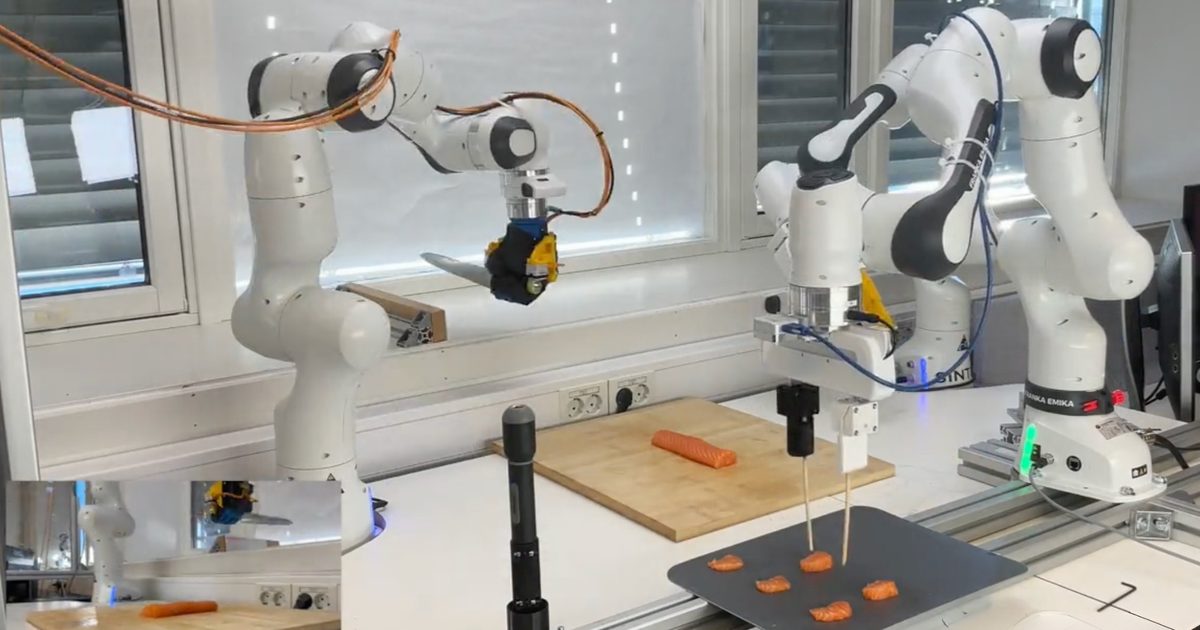
A research group at the Norwegian University of Science and Technology tackled this challenge, creating the Sashimi‑Bot – a three‑armed machine that can carve sashimi from a salmon loin completely autonomously.
How does the Sashimi‑Bot achieve this?
It allocates the work among its three limbs: the first arm steadies and positions the fish on a cutting board, the second wields a chef’s knife to make the cuts, and the third uses chopsticks to pick up each slice and place it on a serving tray.

What sets this system apart is the way the robot learned the skill. Lead researcher Sverre Herland and his team employed deep reinforcement learning inside a virtual simulator, allowing the robot to rehearse thousands of motions and improve through trial and error without ever touching a real fish.
During real‑world testing, the knife‑holding arm was equipped with a GelSight tactile sensor – a soft gel surface with an embedded camera that signals the exact moment the blade contacts the board. The robot produced 34 salmon slices, successfully grasping 26 of the 28 pieces that landed on the board with chopsticks, and retrieving an extra six slices that clung to the blade.
Each cutting cycle took an average of 27.9 seconds. The findings, published in *npj Robotics* (via TechXplore), demonstrate that while most robots excel with rigid, predictable objects, the Sashimi‑Bot showcases how machines can handle delicate, irregular materials by making real‑time adjustments.