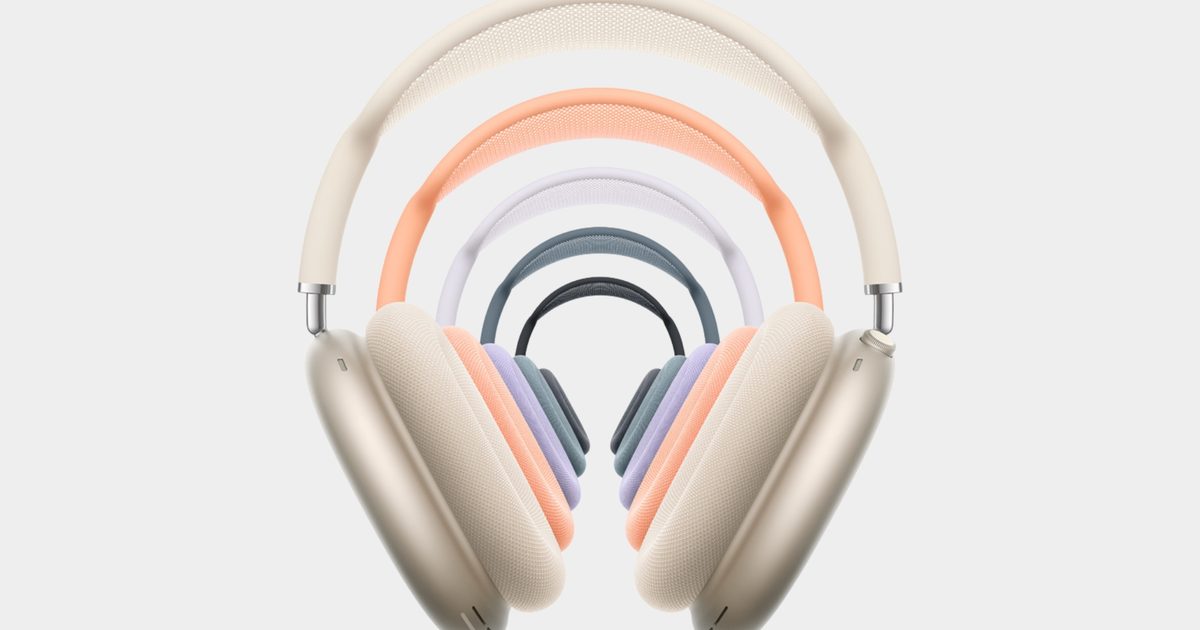
After five years, Apple has updated the AirPods Max with a new H2 chip, improved noise cancellation, and a broader set of features that bring them closer to the rest of its audio lineup. On paper, this is a meaningful upgrade. In practice, it’s more selective.
What Apple has changed this time
The biggest shift is the move from dual H1 chips to dual H2 chips, the same silicon used in the newer AirPods Pro. That upgrade enables a range of features that were previously missing on the Max.
Active noise cancellation is now claimed to be up to 1.5 times more effective, while transparency mode has been tuned to sound more natural. Adaptive Audio blends both modes depending on your surroundings, and Conversation Awareness lowers playback when you start speaking.
Apple has also added personalized volume, which adapts to your listening habits over time, along with loud sound reduction to manage sudden spikes in external noise. Live translation is now supported as well, allowing real-time conversations across languages through the headphones.
Sound improvements are part of that upgrade
Alongside these changes, Apple is introducing a custom high dynamic range amplifier designed to improve bass response, vocal clarity, and instrument separation, while reducing distortion at higher volumes.

The original AirPods Max already offered a warm, balanced sound signature, so this update appears focused on refinement rather than a complete retuning. The combination of improved processing and stronger noise cancellation is likely where the biggest perceptible gains will come from.
Lossless audio arrives, but with a limitation
Lossless audio support has finally been added, with 24-bit, 48kHz playback now available through a wired USB-C connection.
Over Bluetooth, audio remains limited to AAC, with no support for higher-bandwidth wireless codecs. This means lossless listening still requires a cable, which stands out for a premium pair of headphones in 2026.
Additional features and how they translate in use
Apple is also extending functionality beyond audio playback. The digital crown can now act as a remote shutter for an iPhone camera, while voice isolation is positioned as a way to improve call clarity and enable more flexible recording scenarios.

Head gesture controls have been added for interacting with Siri, allowing users to respond by nodding or shaking their head. These features align the AirPods Max with capabilities already available on AirPods Pro, although their practicality varies depending on context, particularly with a larger over-ear design.
What hasn’t changed still stands out
Despite the internal upgrades, the physical design remains largely the same. The AirPods Max 2 retain the metal construction, non-folding structure, and the Smart Case, which continues to offer minimal protection and primarily serves to put the headphones into a low-power state.
There is still no dedicated power button, meaning the case remains necessary for managing battery usage. Battery life is unchanged at around 20 hours, which is increasingly modest compared to competitors offering closer to 30 hours or more.
The headphones are slightly heavier at around 386 grams, do not fold for easier storage, and still lack any official water or dust resistance rating.
What this upgrade really delivers
The AirPods Max 2 are a clear upgrade in areas driven by processing and software. The H2 chip enables a more adaptive listening experience, while improvements to noise cancellation and sound processing should translate into better overall performance.
At the same time, the design, usability limitations, and long-standing hardware concerns remain unchanged.
Is it enough to justify the update?
That depends on what you were waiting for. If better sound refinement, stronger noise cancellation, and deeper integration with Apple’s ecosystem were the priority, this update delivers.
If the expectation was a broader redesign that addressed comfort, portability, and everyday usability, the AirPods Max 2 will feel more familiar than new.