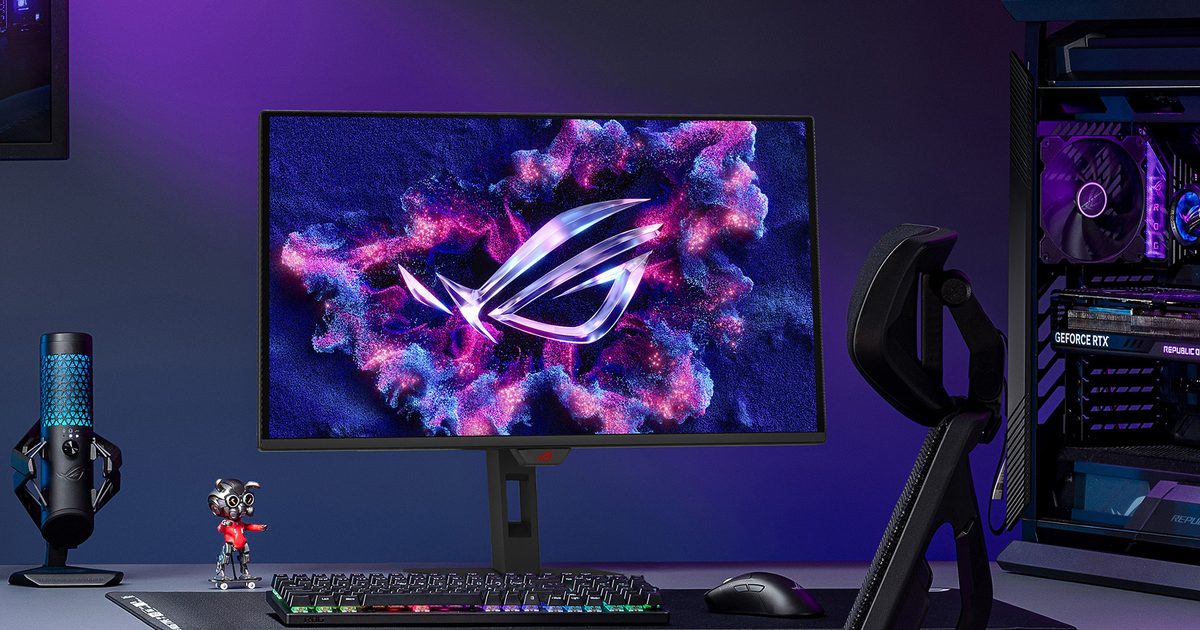
For years, monitor advancements followed a familiar trajectory. Resolution climbed steadily, refresh rates ticked upward, and panel tech matured gradually. Upgrades felt like minor tweaks rather than game-changers.
That trend is now breaking.
A fresh generation of display tech is redefining monitor capabilities and, crucially, their applications. OLED technology is proving viable outside gaming circles. Refresh rates are soaring past what users once deemed essential. Ultra-high-resolution screens are starting to replace multi-monitor arrangements.
These aren’t random updates. Together, they signal a category growing in several directions simultaneously.
OLED Breaks Free From Its Past Constraints
 ASUS
ASUSOLED has long been tied to gaming, thanks to its superior contrast and rapid response times. This experience remains unmatched by standard LCD panels.
 ASUS
ASUSThe hurdle has always been daily usability.
Early OLED monitors often suffered from poor text sharpness due to subpixel arrangements unsuited for desktop work. Performance in bright rooms also diminished perceived contrast, limiting their versatility.
New QD-OLED panels tackle both issues. RGB stripe arrangements enhance text rendering, making these screens better for productivity. Meanwhile, panel-level upgrades help preserve deep blacks even in well-lit spaces.
This places OLED in a more balanced role. It is no longer restricted to one niche.
This shifts OLED from a specialized option to a more balanced, all-purpose display category.
Refresh Rates Hit New Heights
 Sony
SonySpeed remains a key priority.
 Sony
SonyMonitors now hit 550Hz at 1440p, with optional modes pushing refresh rates past 1000Hz by dropping resolution. These numbers reflect a responsiveness level that goes beyond typical expectations.
For most users, the difference might not be obvious right away. For competitive gamers, even minor latency drops can matter.
What stands out more is how these speeds are supported. Technologies syncing strobing with refresh rates are improving motion clarity without causing flicker or ghosting.
At this level, clarity and consistency matter as much as the headline numbers.
Motion Clarity Emerges as a Core Focus
The focus is no longer just about boosting refresh rates. How motion is rendered is now being refined separately.
New methods aim to cut motion blur while sidestepping older technique flaws. This yields smoother visuals that feel steadier during rapid movement.
Some 360Hz displays now deliver motion clarity nearing much higher effective refresh rates. This changes how performance is judged, especially for fast-paced content.
Ultra-High Resolutions Reshape Workspaces
Resolution is also advancing in a more practical direction.
 Samsung
6K screens are starting to emerge, offering far more screen space than standard 4K monitors. With nearly 20 million pixels, these displays let users multitask across apps without extra screens.
 Samsung
This creates a more unified workspace. It eliminates bezel gaps and reduces inconsistencies between displays.
This flexibility reflects a broader shift toward monitors that adapt to various use cases.
These Shifts Extend Beyond Flagship Models
While much of this innovation shows up in high-end models, it is starting to reach more affordable price points.
OLED monitors, in particular, are becoming more accessible. Configurations featuring high refresh rates and fast response times are now available at significantly lower prices than before.
At the same time, well-calibrated LCD monitors continue to deliver strong performance for both creative work and general use.
This ensures that newer technologies aren’t locked to premium devices for long.
A Category Expanding, Not Just Improving
What makes this moment notable is not one breakthrough, but the combination of several.
Image quality is advancing through OLED progress. Speed is increasing via higher refresh rates and better motion handling. Resolution is expanding to support more complex workflows.
These changes are broadening what monitors can do, rather than simply improving existing capabilities.
For users holding onto older displays, this shift represents something more meaningful than a routine upgrade cycle.