For years, I’ve anticipated that Android would finally commit to desktop mode as a core feature. Back in 2019, I purchased a OnePlus 7 Pro and spent a frustrating amount of time attempting to force its incomplete desktop mode into a functional experience.
The concept was logical even then. Smartphones were already incredibly capable, and the notion of carrying a full computer in my pocket felt less like a futuristic fantasy and more like an obvious next step.
What frustrated me wasn’t the concept itself, but the prolonged delay. Devices like the Steam Deck demonstrated that connecting a compact device to a desktop setup could genuinely work, while Google appeared to lose momentum in advancing Android in that direction.
 A Pixel 8a powering a desktop-style setup through a USB-C hub with HDMI, keyboard, mouse, and Bluetooth speaker connectivity Paulo Vargas / Digital Trends
Samsung, on the other hand, continuously improved DeX in full view. I’ve spent years observing r/SamsungDex, watching users create desktop environments powered by their phones, while feeling frustrated that the version I desired most was confined to an ecosystem I never fully embraced.
 Samsung Galaxy S24 Ultra connected to the hub, with the phone doubling as a touchpad. Paulo Vargas / Digital Trends
 Paulo Vargas / Digital Trends
Thus, when Android 16 introduced a connected-display desktop session for compatible Pixel devices, it felt like an acknowledgment that desktop mode had lingered too long as a quirky experiment—part promise, part hobby project.
 The Samsung DeX home screen keeps its desktop settings independent from the phone, so customizations stay specific to each mode. Paulo Vargas / Digital Trends
Now, it is finally being recognized as an integral component of Android.
 Android 16 desktop mode on the Pixel 8a. Paulo Vargas / Digital Trends
Stock Android Matures
Android 16’s desktop mode is now integrated into supported Pixel phones, which theoretically marks a significant milestone for stock Android.
 Camera preview is wonky, but pictures taken are fine. Paulo Vargas / Digital Trends
 Playing Mini Metro on the desktop mode. Paulo Vargas / Digital Trends
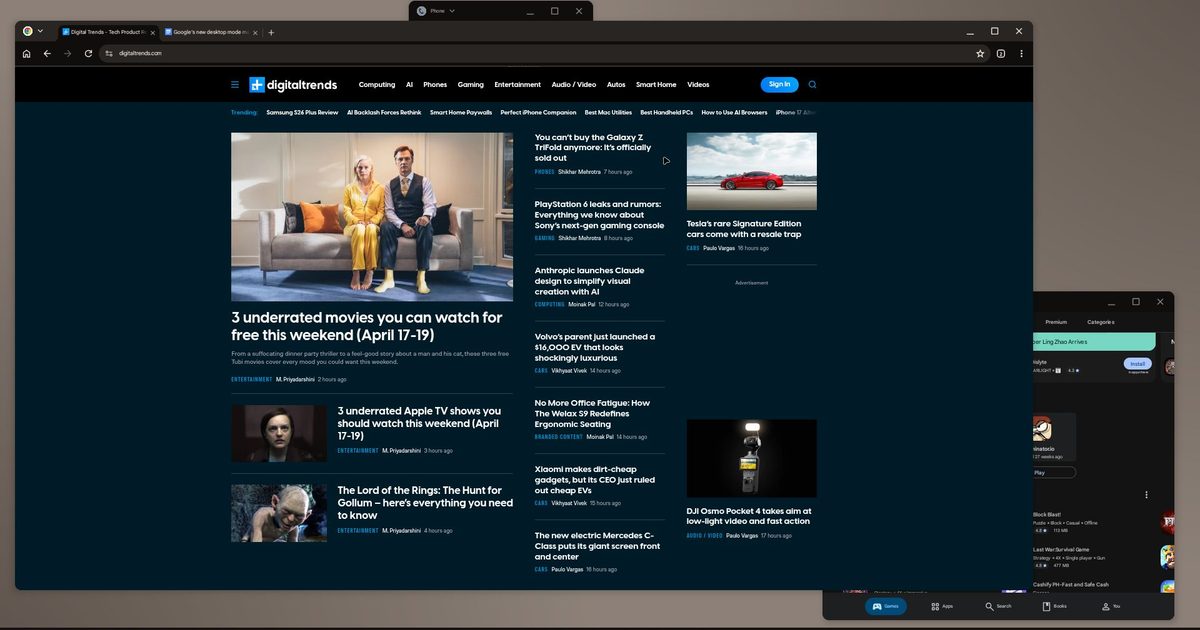
Connecting a Pixel 8 or later to an external monitor enables a desktop-like environment featuring a taskbar, resizable windows, app snapping, and keyboard shortcuts, rather than merely duplicating the phone’s display.
 Paulo Vargas / Digital Trends
This represents the strongest indication yet that Google intends for Android to function beyond a mobile OS when the hardware clearly supports greater ambitions.
That should be a positive development. And largely, it is. Yet it also highlights an uncomfortable reality: Samsung has been executing this strategy for years, with considerably more confidence and consistency.