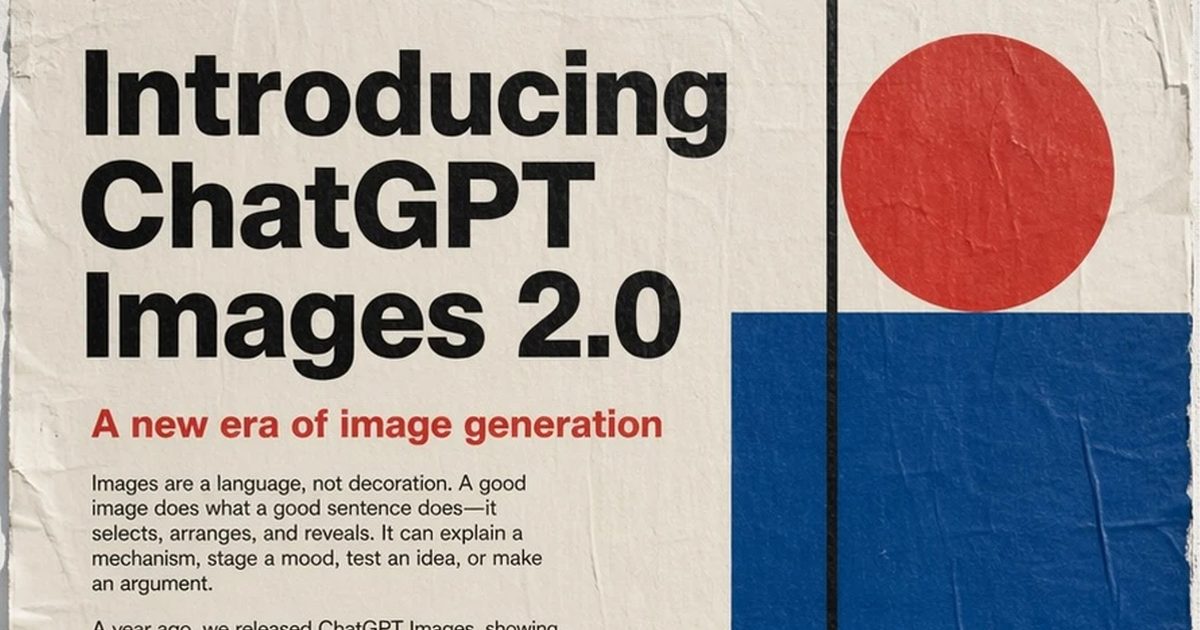
OpenAI has rolled out a significant enhancement to ChatGPT’s visual creation tools, marking a shift from novelty to practical application. The company has announced ChatGPT Images 2.0, a revamped system that prioritizes logical reasoning and precision in visual generation.
ChatGPT Images 2.0 Prioritizes Comprehension Over Mere Creation
Rather than instantly converting requests into pictures, the updated model employs a more thoughtful process, analyzing your instructions before producing the final image.
 OpenAI
This evolution is evident in several improvements. The system now excels at interpreting intricate instructions, ensures visual coherence across different generations, and significantly improves text placement within images—a long-standing challenge for previous AI models.
 OpenAI
Additionally, the system can produce multiple iterations from one request while preserving the central concept, greatly enhancing its utility for workflow adjustments. This creates a tool that behaves less like a random art generator and more like a collaborative partner that grasps your creative intent.
AI Imagery Begins to Enter the Mainstream Workspace
The significance of this update lies in OpenAI’s strategic shift. The focus is no longer on creating viral artistic content but on developing practical image generation for everyday tasks. With enhanced text clarity, structural integrity, and consistent results, ChatGPT Images 2.0 becomes viable for presentations, social media assets, and rapid prototyping. While it does not yet replace professional software, it is rapidly approaching the capability to manage a wide range of routine design needs.
However, imperfections remain, particularly with intricate compositions or non-English characters. Yet, the advancement since last year is undeniable. As this trajectory continues, the distinction between “AI-generated” and “professionally viable” visuals will blur rapidly. ChatGPT Images 2.0 is live now for all ChatGPT and Codex users, with advanced reasoning outputs accessible to Plus, Pro, Business, and Enterprise subscribers. The core model, gpt-image-2, is also accessible via the API.