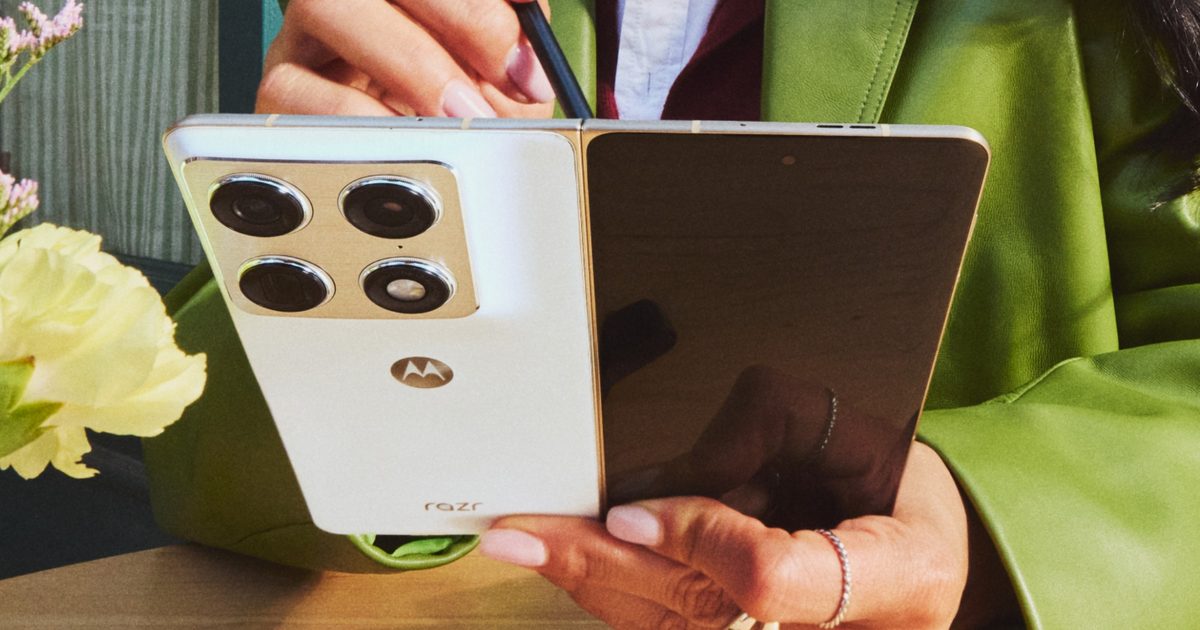
If there’s one major hurdle preventing foldable phones from becoming mainstream, it’s their battery endurance, and Motorola is stepping up to address this issue. Nearly every major smartphone manufacturer in the U.S. has released a book-style foldable, justifying the high price with complex hinges, flexible screens, and other technical achievements. However, battery performance often falls short of expectations.
Unfolding a foldable doubles the screen size, which is its main selling point. But does the battery life also double? Unfortunately, no. Among the two most popular book-style foldables available in the U.S. — Samsung’s Galaxy Z Fold 7 and Google’s Pixel 10 Pro Fold — the average battery life still lags behind that of traditional smartphones.
 Motorola
Yet, smartphones have already achieved over 10 hours of screen-on time using silicon-carbon battery technology. This is precisely the gap Motorola aims to close with its inaugural book-style foldable, the Razr Fold. For the first time, a foldable is entering the U.S. market boasting a 6,000 mAh battery with 80W wired charging support.
If successful, the Razr Fold could close this battery life gap before Samsung or Google even attempt to match it.
The Persistent Battery Challenge for Foldables
Consider what the battery in the Fold 7 or Pixel 10 Pro Fold must power: two displays (the outer cover screen and the inner foldable screen), a flagship-grade processor taken directly from standard slab phones, and at least two or three rear cameras, plus constant Wi-Fi or cellular connectivity.
This compounded power demand means foldables need larger batteries to match the endurance of regular phones. A few years ago, when foldable technology was less advanced, using a 4,000 or 4,400 mAh battery was standard practice.
 Motorola
To me, it seems like OEMs, particularly in the U.S., are intentionally limiting battery capacity in foldables, while Chinese brands like Honor and Oppo continue to push boundaries.
This is the core issue the Motorola Razr Fold could resolve.
Who is the Razr Fold Up Against?
I’ve briefly used the Fold 7, and by many metrics, it’s an impressive piece of technology. The thinnest book-style foldable in the U.S. measures just 4.2 mm when unfolded. However, with a 4,400 mAh battery providing around six hours of screen-on time on average, it didn’t last a full day for me.
The phone also takes roughly 90 minutes to fully charge, thanks to support for only 25W wired charging. You can’t just plug it in for 20 minutes before heading out; you’d have to plan around it.
 Nirave Gondhia / Digital Trends
 Nirave Gondhia / Digital Trends
Google’s Pixel 10 Pro Fold made a significant jump with a 5,015 mAh cell and up to 39W charging, delivering between seven and eight hours of screen-on time, genuinely lasting a full day of usage.
But is that enough? Not really. Now that we’re in the era of phones with batteries exceeding 7,000 mAh (I’m referring to the OnePlus 15 and the OnePlus 15R) that offer nearly two days of battery life between charges, plugging in a foldable at around 8 or 9 PM feels like getting shortchanged on a $2,000 purchase.
If foldable phones are to compete with mainstream handsets, manufacturers must improve battery life, which is exactly why the Razr Fold has caught my attention.
What to Expect from the Razr Fold?
The Razr Fold’s 6,000 mAh battery is roughly 36% larger than the Galaxy Z Fold 7’s and about 20% larger than the Pixel 10 Pro Fold’s. Motorola achieved this using the same technology found in modern Chinese flagships: silicon-carbon battery chemistry, which packs more energy into less physical space without adding bulk. The result is a book-style foldable that unfolds to just 4.7 mm, slightly thicker than the Fold 7, but not by a margin that should concern anyone.
Now, this is where I’m using years of experience to speculate without trying to sound overly optimistic. The Razr Fold, with its 6,000 mAh battery and the Snapdragon 8 Gen 5 chip that’s actually less powerful than the Snapdragon 8 Elite on the Fold 7, should provide a screen-on time of around eight to nine hours under mixed usage.
 Motorola
If Motorola has optimized the software well for a large-screen foldable, and that’s a big if, given that this is the company’s first foldable, the screen-on time might even exceed nine hours.
This way, the foldable could actually match the battery life of modern flagships. If that doesn’t happen, however, I’d be disappointed, and seven to eight hours is where the phone would sit, with the Pixel 10 Pro Fold, despite featuring a significantly bigger battery.
Please Don’t Miss the Mark, Motorola
Charging speed is equally crucial here. The Razr Fold’s 80W wired charging speed is more than three times what Samsung offers on the Fold 7 and double what Google offers on the Pixel 10 Pro Fold. The caveat, here, is that none of this has been proven yet, and we’ll have to wait a couple of weeks to find out the truth.
 Motorola
It’s worth noting that the company also promises over 12 hours of use from under 10 minutes of being plugged in. For added convenience, and to leave the competition baffled, the Razr Fold also supports 50W wireless charging. While achieving those speeds requires Motorola’s proprietary hardware, I’d definitely pay for that kind of speedy convenience.
Moreover, the Razr Fold’s 6,000 mAh battery, paired with 80W wired and 50W wireless charging, is the spec combination that U.S. buyers deserve. If it delivers, it will bridge the gap between the battery life we get from regular smartphones and foldables, making the Razr a compelling buy and forcing Samsung and Google to go back to the drawing board.