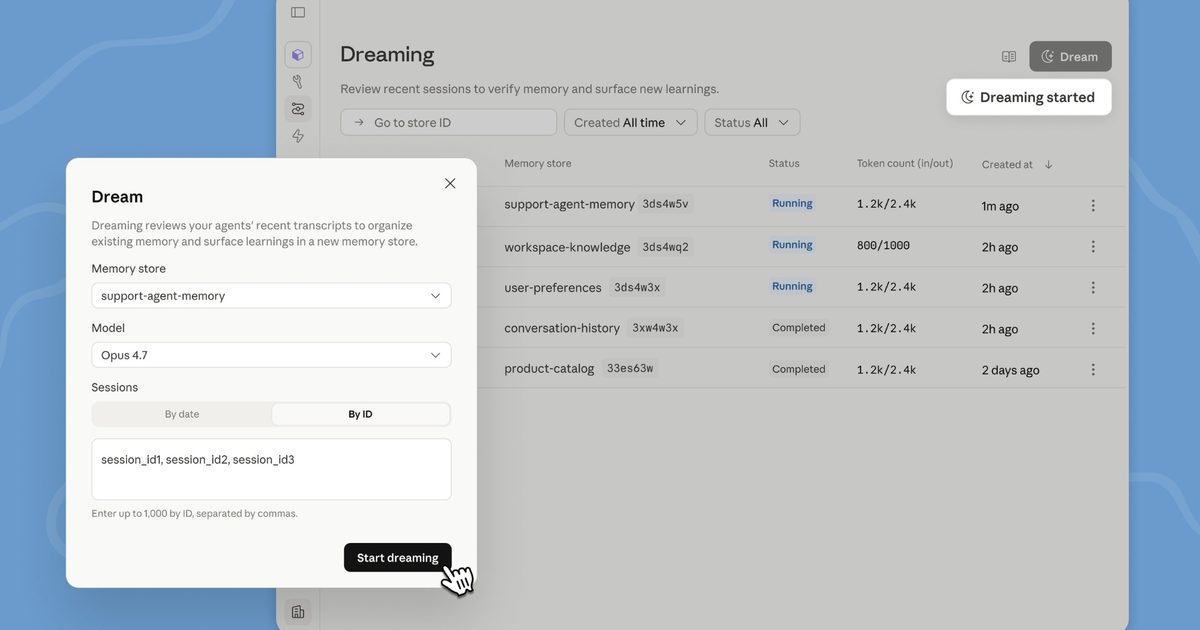
Techgeeks reports that Anthropic has introduced a feature to Claude that resembles a concept from science fiction: the capacity to dream. The firm has unveiled three enhancements to Claude Managed Agents: Dreaming, Outcomes, and Multiagent Orchestration.
Although the Dreaming feature boasts the most imaginative title, it also offers the most significant practical benefits for developers creating AI agents capable of managing complex, extended tasks.
Understanding Claude’s Dreaming Capability
Beneath its poetic moniker, Dreaming functions as a scheduled background operation that occurs between active sessions. It is designed to analyze all previous agent activities, such as past dialogues, stored memory, finished tasks, and identify recurring patterns.
Dreaming examines every task executed by the agent, detects repeated errors, recognizes preferred methodologies developed over time, and distributes these insights among multiple parallel agents (when several Claude agents operate simultaneously).
After processing this information, the agent solidifies these learnings into its memory, ensuring each new session begins with the context of past successes and failures. Developers have the option to allow Dreaming to update memory automatically or to manually review changes before they are implemented.
The Role of Outcomes and Multiagent Orchestration
Currently, the Dreaming feature is accessible via research preview on the Claude Platform. This self-improvement tool aids agents in accumulating value over time by recognizing and learning from errors made in prior sessions.
As its name implies, Outcomes enables developers to establish specific parameters, requirements, or standards for evaluating the agent’s output. A distinct grading system performs this evaluation to ensure it remains unbiased by the agent’s own reasoning. If the output fails to meet the criteria, the grader prompts the agent to try again.
Multiagent Orchestration facilitates the collaboration of multiple Claude agents on different segments of a complex task. This approach decreases processing time and broadens the scope of responses within a single workflow. Webhooks complete the update by allowing event-driven triggers for agents, eliminating the need for continuous manual prompting.