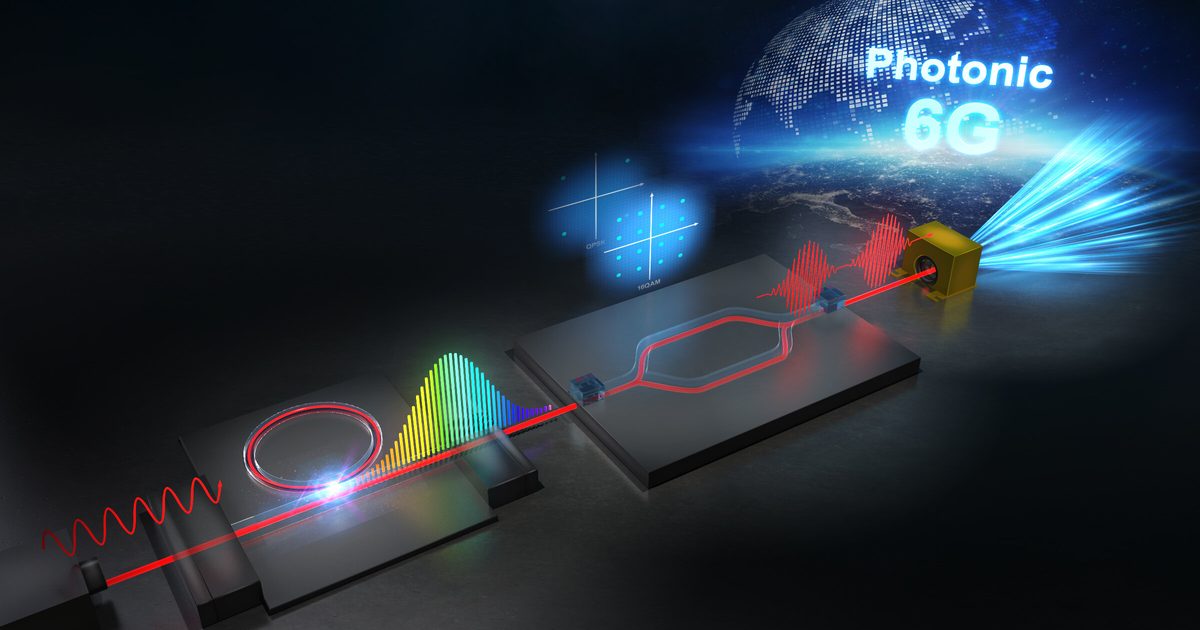
Scientists have pushed wireless speed into territory that current mobile networks can’t touch. A Tokushima University team demonstrated a 112Gbps wireless connection in the 560GHz band, using soliton microcombs to generate a more stable terahertz signal for future 6G systems.
The near-term prize isn’t a faster handset. It’s the hidden infrastructure that carries traffic between network sites, where backhaul capacity can decide whether future 6G speeds feel real or get trapped behind crowded network pipes. That makes this a useful 6G speed breakthrough to watch, even if consumers won’t see it on a spec sheet anytime soon.
Why does this record carry weight
The 560GHz band gives the 112Gbps result its edge. The team sent a single-channel wireless signal well beyond the range where conventional electronic hardware starts running into weaker output power and higher signal noise.
That frequency range sits in the terahertz zone, which researchers are exploring as a way to open wider data lanes for 6G. Earlier communication systems at these frequencies have often stayed in the range of a few to several dozen gigabits per second. This test crossed the 100Gbps class beyond 420GHz, which pushes the work into a more serious category.
How did the signal stay clean
At these frequencies, raw speed depends on control as much as bandwidth. Phase noise and limited output power make wireless transmission harder to keep stable, especially when a system is trying to move more data through one channel without the signal falling apart.

When do real networks get closer
No one should read this as a phone upgrade arriving soon. The researchers still need to cut phase noise further, support higher-order modulation, improve terahertz output power, and extend transmission distance with better antenna design.
The first useful home for the technology will probably be mobile backhaul or photonic-wireless network links. That’s less visible than a new 6G phone, but it’s more important to the network itself. Before 6G can deliver massive speeds to everyday devices, the infrastructure behind those devices needs a faster way to move data around.