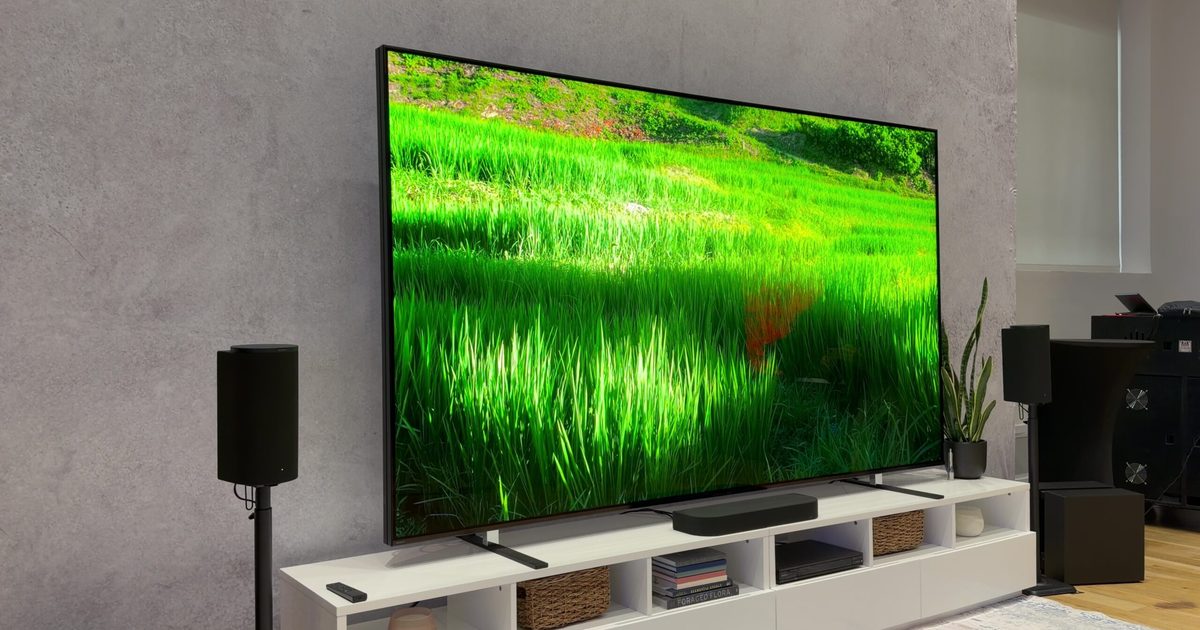
The fight for premium‑TV shoppers has lately been a showdown between OLED and Mini LED. OLED is praised for its deep blacks, strong contrast and wide viewing angles, while Mini LED pushes peak brightness to new levels. Buyers have often had to choose which compromise best fits their room and watching habits.
Sony thinks that balance may soon shift. At a private media briefing in New York, the company introduced a new display concept called True RGB, which re‑imagines the TV backlight and seeks to blend the strongest attributes of both OLED and Mini LED.
**Sony says most TVs are built for the wrong setting**
One of the more striking remarks from the briefing wasn’t about specs at all. Sony noted that only about 13 % of viewers watch TV in a pitch‑black environment like product demos, cinema rooms, or professional colour‑grading suites. The remaining 87 % are in living rooms, family rooms, or other spaces where ambient light is constantly changing.
Sony argues that many high‑end panels still struggle to keep brightness, colour accuracy and contrast in sync once they leave ideal lighting conditions. That, according to the company, is the problem True RGB is meant to solve.
**What sets True RGB apart?**
To see why Sony believes the technology matters, it helps to understand how most premium TVs currently generate colour. In a typical Mini LED or QLED panel, a blue or white backlight works with quantum dots, phosphor layers and LCD structures to produce the final image. In other words, most of the colour creation happens after the light leaves the backlight.
True RGB flips that approach. Instead of a single‑colour light source that is later filtered, Sony places individually controllable red, green and blue diodes directly inside the backlight. The desired colour is therefore produced at the source, before it even reaches the LCD layer.
To achieve this, Sony’s professional‑monitor engineers teamed up with the BRAVIA consumer group to create a new RGB Backlight Master Drive. Sony says the updated driver architecture can control millions of microscopic red, green and blue diodes in real time.
**Colour volume could be the biggest gain**
Sony staged side‑by‑side demos pitting True RGB against competing flagship panels, using both 100 % and 90 % raster windows. While several differences were highlighted, colour volume emerged as the most striking.
Because True RGB generates pure red, green and blue light at the source, Sony claims the system can express far more colour while still delivering high brightness. The company states that True RGB offers twice the colour volume of the BRAVIA 9 Mini LED and up to four times that of the BRAVIA 8 OLED.

The result is a screen that can get extremely bright without washing out colour saturation.
**Viewing angles get a boost**
Wide viewing angles have historically been OLED’s strong suit. Mini LED panels can lose colour fidelity when viewed from the side because much of the colour is formed through the LCD layer.
Sony says True RGB mitigates this issue by creating colour both in the LED layer and the LCD layer, rather than relying on a single stage. Demonstrations showed side‑by‑side comparisons where colours stayed more consistent even at extreme angles.
**Smoother gradation reduces banding**
The third major advantage Sony highlighted was gradation performance. Colour banding often appears in skies, sunsets and other scenes with subtle transitions, especially on bright screens.
By pairing its image‑processing tech with independent control of the red, green and blue backlight, Sony claims True RGB dramatically cuts visible banding and delivers smoother shade transitions.
**First flagship TVs to feature True RGB**

The inaugural True RGB model will sit at the top of Sony’s lineup as the BRAVIA 9 II, available in 65‑, 75‑, 85‑ and 115‑inch sizes and equipped with RGB Backlight Master Drive Pro and Luminance Booster Pro. Sony says the TV is engineered to match the creative intent and brightness of its professional BVM studio monitors.
The technology won’t be limited to the flagship tier. Sony also announced the BRAVIA 7 II, which brings True RGB to a broader size range from 50 inches to 98 inches. Below those will be the company’s OLED range, led by the BRAVIA 8 II and the standard BRAVIA 8.
**Tackling reflections**
Alongside True RGB, Sony unveiled an optional premium anti‑glare feature called Immersive Black Screen Pro for the BRAVIA 9 II. The patent‑pending nanostructure layer is designed to absorb reflections while preserving deep blacks, even in brightly lit rooms.
This focus on real‑world viewing conditions ties back to Sony’s broader message during the briefing: instead of optimizing displays solely for ideal, dark environments, True RGB is built around how most people actually watch TV at home.
After seeing the demos, it’s easy to understand why Sony believes True RGB could be the next major leap in premium display tech. Whether it lives up to the hype will only be clear once the retail units reach consumers, but Sony is clearly betting that the future of TV performance lies somewhere between what OLED and Mini LED currently deliver.