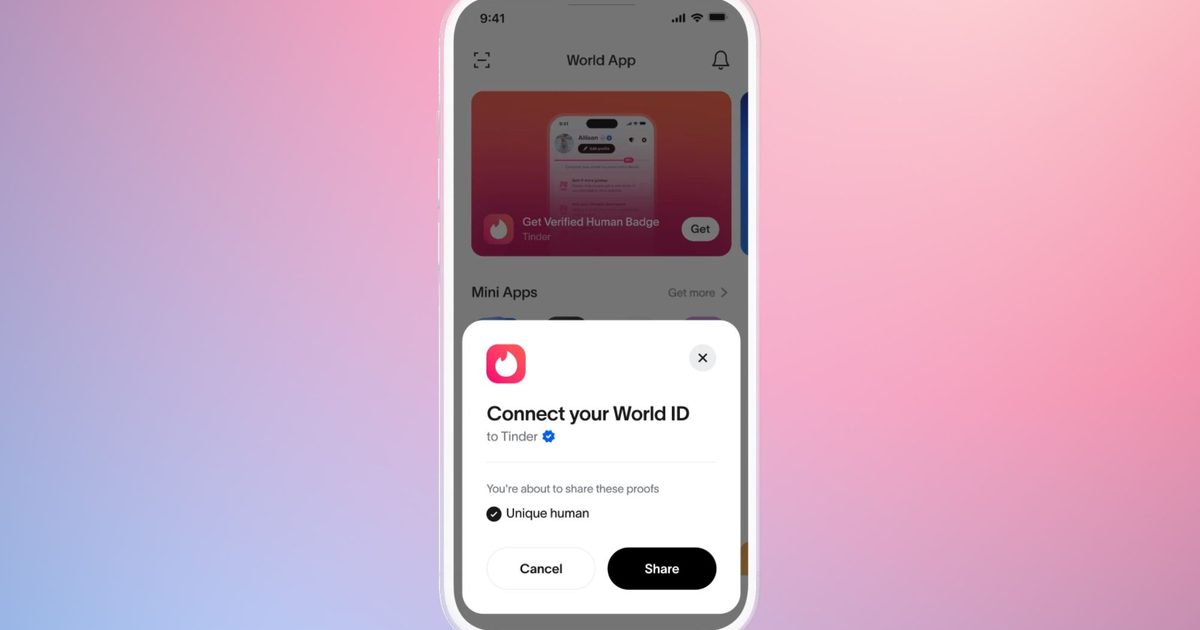
Online dating has long been fraught with trust issues, and now Tinder is introducing an iris scan to the mix. The well-known dating platform has revealed a worldwide collaboration with World, the biometric identity firm established by OpenAI’s Sam Altman. In the near future, Tinder users will have the chance to verify their humanity by having their eyes scanned with a physical orb device.
Understanding World ID and Tinder’s Human Verification Process
 World
WorldWorld operates on the premise that verifying human identity online will grow increasingly crucial as AI-generated accounts proliferate and potentially outnumber actual humans on the web. Its answer is a unique scanning tool known as the Orb, which captures iris data at physical locations to confirm a user’s authenticity.
After verification, individuals are issued a World ID tied to that scan. Tinder previously trialed this verification method in Japan earlier this year, and the positive results prompted a global expansion.
 World
WorldTinder users who complete the World ID verification will earn a profile badge confirming their human status. To encourage participation, Tinder is providing five complimentary Boosts to those who finish the process. The company believes this perk will motivate users to share their biometric information.
Is the World Orb Expanding Beyond Dating Apps?
 World
WorldTinder is merely the start. Zoom is incorporating World ID to allow meeting organizers to confirm attendees’ identities before calls begin. DocuSign is also embracing the technology, enabling users to mandate World verification for contracts. Additionally, Reddit could implement World ID to combat bot accounts.
Furthermore, World has introduced Concert Kit, a feature that allows musicians to sell tickets exclusively to verified humans, directly targeting scalper bots. Concert Kit will soon be piloted at a Bruno Mars World Tour concert in San Francisco.
Despite World’s push for widespread adoption, governments in Brazil and other nations have prohibited the technology due to privacy worries. Whether sharing biometric data with third parties becomes standard practice is an issue that will only intensify in the coming years.