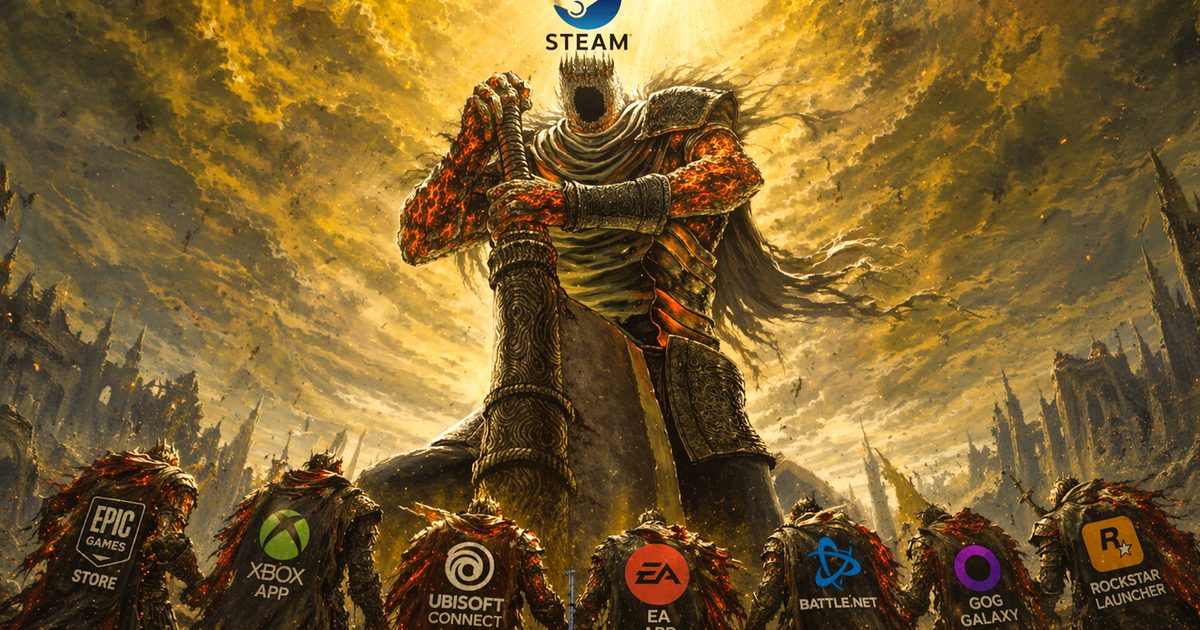
Turn on any gaming PC, and you’ll likely find the blue Steam icon waiting for you on the desktop. It’s no longer just an option or a hidden utility; it’s practically a standard feature. Over the years, Steam has evolved from a simple launcher into the go-to marketplace for PC gaming, feeling as integral to the experience as the hardware itself.
The Invisible Monopoly
Data from sources like QuantumRun and IconEra suggests Steam commands about 70 to 80% of the PC digital distribution sector. This isn’t merely a lead; it’s an overwhelming majority. Alongside this dominance comes the traditional 30% commission model, which decreases as sales volumes rise. This mirrors the fee structures employed by tech giants like Apple and Google, a practice that has drawn sustained criticism from game creators for years.
In fact, a past GDC poll showed that only 6% of developers believe Steam justifies its 30% cut. Theoretically, these factors—massive market share, a rigid fee structure, and deep user integration—define a monopoly. In most sectors, this would trigger immediate regulatory or public scrutiny. However, the PC gaming world has reacted quite differently.
“Valve is the only major store still holding onto the payments tie and 30% junk fee” – Tim Sweeney, CEO, Epic Games
Steam isn’t the only player in the arena. Epic Games Store launched with a bold strategy, offering a lower 12% revenue share and a constant supply of free titles, including high-profile releases. Microsoft took a similar step in 2021, reducing the Windows Store fee for developers from 30% to 12%.
Theoretically, this should be a winning strategy. Microsoft also leverages its Xbox app and Game Pass subscription service to secure a strong foothold. Meanwhile, major publishers like Ubisoft and Electronic Arts have attempted to consolidate their user bases within their proprietary launchers to maintain control over distribution and profits.
 Varun Mirchandani / Digital Trends
Despite these alternatives, user habits remain largely unchanged. Players might grab free titles on Epic, install other launchers when necessary, or utilize Game Pass for certain games. However, when it comes to purchasing games and curating a personal library, the vast majority return to Steam. Competition is present, but it hasn’t fundamentally altered how gamers behave.
Steam’s Own Challenges
It would be inaccurate to claim Steam has had an unblemished history. The community has pushed back significantly on several occasions. Prior to 2015, the absence of a robust refund policy was a major grievance, prompting Valve to implement the now-standard two-hour refund rule.
Similarly, the attempt to monetize mods for “The Elder Scrolls V: Skyrim” provoked intense backlash, leading to a swift reversal. Developers have consistently voiced concerns regarding visibility, discoverability, and the persistent 30% revenue share, which remains a hotly debated subject.
 Steam
SteamThe recurring theme, however, is interesting. Controversies arise, Valve responds or makes adjustments, and the situation stabilizes. There has never been a mass exodus from Steam due to these issues. Users complain, yet they remain. This cycle has repeated so frequently that it has become ingrained in the platform’s culture.
Why Gamers Accept the Status Quo
The most straightforward explanation is often the most valid: Steam simply functions well. It does more than just launch games; it encapsulates the entire PC gaming experience into a unified ecosystem. Consider performance and reliability first.
Steam’s servers are among the most consistent in the industry.
Downloads are swift, updates are managed seamlessly, and service interruptions are uncommon. While the client isn’t lightweight, it is stable, reliable, and rarely obstructs the user. This reliability alone gives it an edge over many competitors that still grapple with basic usability issues.
 Steam Server Status SteamStat.US
Furthermore, the feature set is where Steam subtly outpaces the competition. Cloud saves have been a standard for years. Achievements, though basic, are deeply woven into the platform. The Steam Workshop simplifies modding for casual users, transforming complex setups into single-click actions.
Remote Play enables game streaming to other devices or cooperative play with friends who don’t own the title. Controller support is another highlight, offering granular input customization that many other platforms ignore.
 Steam
SteamOver time, these features transition from bonuses to necessities. Interestingly, Steam Chat is regaining traction as a viable Discord alternative, especially since Discord began mandating ID verification. Competitors often fall short here.
While the Epic Games Store may provide better financial terms for creators, it misses out on many of these ecosystem-wide features. The Xbox app excels at subscriptions but lacks the sense of permanent ownership.
Other launchers feel like tools. Steam feels like a home.
 Steam
SteamSales are also a massive driver. Steam’s seasonal events have become cultural touchstones. The Summer and Winter Sales are anticipated events, akin to Amazon’s Prime Day, if not more so.
Steep discounts, flash deals, and wishlist alerts create an engaging loop that keeps users hooked. Over time, this has conditioned gamers to view Steam as the place for value. Even at full price, many users instinctively wait for a sale.
The Power of the Ecosystem
Another often-ignored element is the community layer. Steam reviews influence purchasing choices significantly. User tags, forums, guides, and discussion hubs transform each game into a dynamic community rather than a static product page. This creates a positive feedback loop where players assist each other, strengthening the platform.
 Steam
SteamThen there is library lock-in, which is less malicious than it sounds. Many players have spent years curating their Steam libraries, sometimes owning hundreds of titles. Switching platforms isn’t technically hard, but it feels like a hassle. Everything is organized, updated, and accessible in one spot.
That kind of convenience is hard to walk away from.
 Valve
ValveThe launch of the Steam Deck has only solidified this position. By making the Steam library portable, Valve has expanded its ecosystem beyond desktops. Features like Proton compatibility have simplified cross-system gaming, adding flexibility. This is also why gamers are eager for the Steam Machine, with console makers aware of the threat Steam poses to the home console market.
A More Favorable Image?
Valve operates differently from most rivals. As a private company, it lacks the pressure to meet quarterly earnings targets. This freedom allows it to take risks, experiment, and fail without resorting to aggressive monetization.
Equally important is the perception of its leadership. Public figures like Gabe Newell have cultivated a reputation for being down-to-earth, boosting the platform’s goodwill. Broadly, Newell is seen as “the good guy of gaming.”
 How the gaming community views Gabe Newell Reddit
This brings up an interesting comparison with Nintendo. Nintendo is adored for its games but often criticized for pricing, online services, and hardware choices. It’s a love-hate dynamic where players endure flaws for the core experience.
Steam sits on the other end of that spectrum.
It isn’t driven by emotional attachment but by earned trust through consistency. It minimizes friction rather than forcing users to navigate it. Furthermore, leaders like Newell often discuss games not as a cash grab, but as a quality experience that benefits everyone — developers, publishers, and players alike.
The Beneficial Monopoly
For gamers, Steam is logical. It’s fast, familiar, feature-rich, and usually the best spot for deals. For developers, however, it’s more complex, with over 50% of devs believing Steam acts as a monopoly, according to Atomik Research’s survey. This divide makes Steam a unique case. It can be frustrating from one angle and incredibly convenient from another. Both perspectives can coexist.
That’s the paradox. Steam exhibits all the signs of a monopoly, yet doesn’t feel like one where it counts. Gamers return not just out of habit, but because no other platform feels as comprehensive. Valve didn’t win by trapping users; it won by making them never want to leave. In a space where players complain about everything, that might be its greatest achievement.