“A terrific foldable phone, if you’re willing to make the brand value plunge.”
- Surprisingly eye-catching looks
- Excellent inner and cover displays
- Strong battery life and fast charging
- Moto Pen Ultra adds real utility
- Reliable main and telephoto cameras
- Smooth everyday performance
- It’s pretty expensive
- Games skip the 120Hz perk
- Software feels barebones
- A tad heavy for one-handed usage
The Motorola Razr Fold had a lot to prove before I even put my SIM card inside it. Motorola has spent years building its modern Razr identity around its iconic flip phones. Some of them were charming beyond the nostalgia bait, and some were genuinely good devices in their own right. But a book-style foldable is a different beast altogether.
This is the arena where Samsung has had years to refine the Galaxy Z Fold formula, while Google has been trying to make the Pixel Fold line feel more useful. So why should anyone trust Motorola’s first attempt?
I was both curious and skeptical. I expected the usual first-gen product problems, whether that meant a questionable hinge, bulky design, or software that was learning how to behave on a foldable screen.
After using the Razr Fold, I don’t think Motorola has made a clumsy first draft.
This is still a first-generation book-style foldable, and it has a few rough edges that remind you of that. However, you also get a surprising amount of polish and thought put into this phone.

It is still a first-generation book-style foldable and has a few rough edges that remind you of that. But there’s also a surprising amount of polish and thought put into this phone. The design feels considered, the hinge inspires more confidence than I expected, the cameras are far more useful than Motorola’s older reputation would suggest, and the Moto Pen Ultra was a nice touch to the whole package.
The big question now is whether all of that is enough. Foldables aren’t experimental products anymore. These are ultra-premium devices that make the iPhone look like a safe investment. So, is the Motorola Razr Fold a serious alternative to Samsung, or is this just a handsome one-off release?

Motorola Razr Fold Specs
| Dimensions | 144.47 x 160.05 x 4.55 mm (open), 160.05 x 73.6 x 9.89 mm (closed) |
| Weight | 243g |
| Display | 8.1-inch LTPO pOLED, 120Hz (Main), 6.56-inch LTPO pOLED, 165Hz (Cover) |
| Screen Resolution | 2484 x 2232 (Main), 2520 x 1080 (Cover) |
| Chipset | Snapdragon 8 Gen 5 |
| RAM | 16GB |
| Storage | 512GB |
| OS | Android 16 OS based Hello UI |
| Rear Cameras | 50MP main / 50MP Periscope Telephoto / 50MP Ultrawide |
| Front Camera | 32MP (Inner), 20MP (External) |
| Battery & Charging | 6,000mAh / 80 wired / 50W wireless |
Design: Motorola Razr Fold dodges the first-gen curse
Quick take: The Razr Fold doesn’t feel like a first attempt, and that might be its biggest design win.
The phrase “first-gen foldable” usually comes with a few warning labels. You expect compromises and some design quirks. However, the Motorola Razr Fold, surprisingly, doesn’t give off that impression.

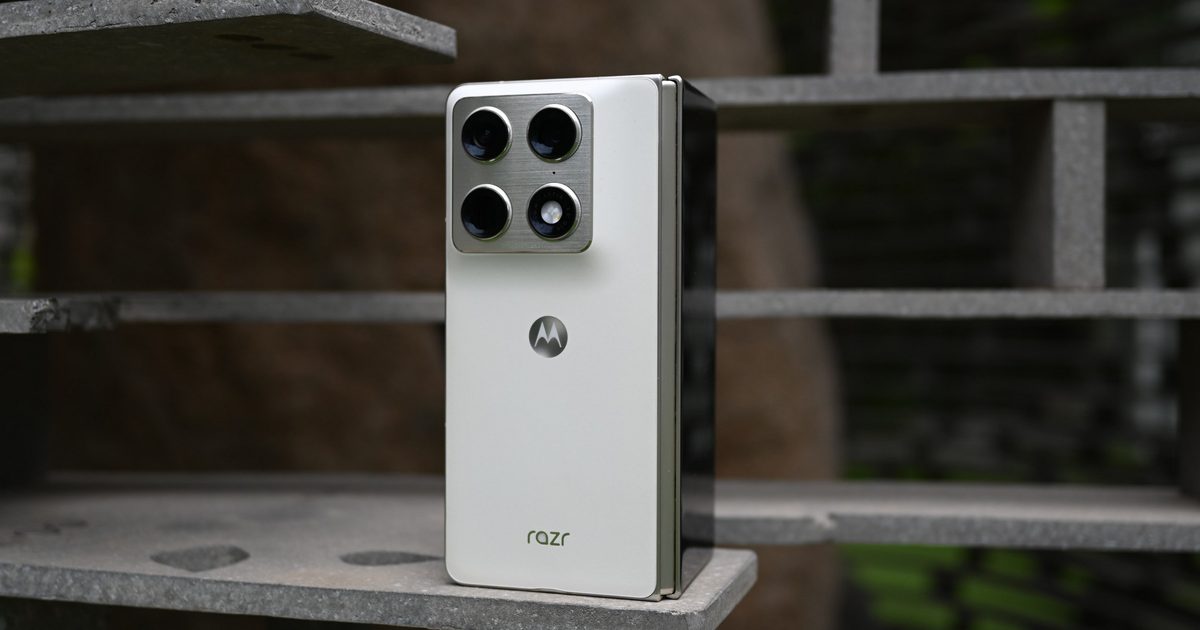
This is Motorola stepping into the book-style foldable space for the first time, and yet, the phone doesn’t come across as a device that’s figuring out what it wants to be. The overall shape feels confident, and the finish gives it more personality than the usual slab of metal and glass. The Pantone Lily White version, in particular, has that soft, almost silk-like look that makes the phone feel like a fashion statement rather than a fragile showpiece.
The chamfered edges also help. They give the frame a cleaner, more premium feel while making the phone easier to grip than I expected. That matters with a foldable, because this is still a big device. You feel the size when it’s closed, and you definitely know you’re holding something more substantial than a regular phone. But Motorola has done a good job making that size feel intentional.

The hinge is the part I was most unsure about, and it ended up being one of the parts that impressed me most. It opens and closes with the kind of resistance that makes you trust it, not baby it. The large inner screen gives you the obvious tablet-like workspace, but the outer display keeps the phone useful when you don’t want to open the whole thing. So Motorola didn’t need a warm-up round. The Razr Fold looks and plays the part of a proper premium foldable.
There are a few quirks, though. It is slightly thicker and heavier than the Z Fold 7 (4.2mm unfolded, 8.9mm folded, and 215g). So the Razr Fold is about 1mm thicker and nearly 30 grams heavier. The weight here is what really makes the difference. It gets really tiring to hold onto after a while. But apart from that, it’s hard to find any faults here with just the design. You also get just an IP48 + IP49 rating. This is great against accidental water immersion and rain, but the body of this phone isn’t “dust-tight”. An IP6X rating is still a rarity among foldables. Still, given how Motorola phones are often advertised with durability in mind, this could’ve been one area the brand could’ve iterated on, which would’ve made me forgive the heavy weight.
Design score: 8.5/10
Displays: Gorgeous screens inside and out
Quick take: Motorola’s first foldable brings a polished folding screen experience on both sides
For many, the cover panel will be the display they interact with the most, so it has to be a solid display and not just an add-on for the big flexible screen. Measuring 6.56 inches tall, it’s not the tallest panel out there, but the 21:9 aspect ratio means that it’s narrower than your typical iPhone or Galaxy. This does make it easier to hold despite its heft, but the trade-off is that one-handed use isn’t always convenient. Although the media shot in a 21:9 aspect ratio feels right at home here.

That nitpick aside, this is still a great screen. You got an LTPO pOLED panel with an FHD+ resolution and a 165Hz refresh rate. So you get sharp pictures and smooth touch inputs. The refresh rate realistically caps off at 120Hz, only hitting 165Hz in select apps and games. Thanks to its peak brightness of 6,000 nits, it also remains perfectly legible in the bright outdoors.
Colors are punchy by default, though you can set them to a more natural tone through the settings. Durability is always a concern with foldables, and the Motorola Razr Fold delivers a strong first impression here as well. It is claimed to be the first foldable to feature Corning’s Gorilla Glass Ceramic 3, and my review unit survived two scary drops, one on pavement and another on a road, with only minor scratches. You can even put up the screen in a tent mode on your desk, which turns the cover into a digital alarm clock.

The real highlight, of course, is the inner display. The 8.1-inch LTPO pOLED panel is the reason this phone exists, and it feels like a proper big-screen experience rather than a stretched-out phone display. Combine the high resolution, 120Hz refresh rate, and strong brightness, and you get a very good foldable formula. There’s no obvious compromise on screen sharpness or quality.
Watching movies or videos on this screen is a solid experience. Gaming becomes more immersive in the unfolded state, even if it doesn’t feel completely natural at first. Reading comics and manga was especially fun because the larger panel lets you appreciate smaller details in the artwork that get lost on a regular phone.
The teardrop-style fold also helps reduce how harsh the crease looks and feels. It’s still there, but in my experience, it’s on the same level as the Galaxy Z Fold 7. A larger screen real estate also enables improved multitasking and document work. The larger canvas also makes multitasking and document work more useful. I wrote a section of this review on the phone, and it felt oddly more comfortable than typing on the conventional cover display.

You also get a desktop mode that lets one half of the inner display work like a regular display, while the other half acts as a trackpad. But this just feels more like a gimmick than a useful feature you’d use often.
The one obvious drawback is the aspect ratio. Unlike the outer panel, the main screen is closer to a square, so you can expect large black bars around a lot of video content. The picture is still larger than what you get on a typical tall flagship, but the gap isn’t always as dramatic as you’d expect once the content actually fits into the display. Rounding out the screen experience is stylus support, though the Moto Pen Ultra is sold separately.
Display score: 9/10
Moto Pen Ultra: The surprise accessory that actually changed how I used the phone
Quick take: The Moto Pen Ultra isn’t just a throw-in productivity accessory; it gives the Razr Fold some of its most memorable tricks.

I’ll be honest, I thought smartphone styluses had mostly gone out of style. The Galaxy Note made them exciting, while the Galaxy Ultras are keeping them on life support. Styluses on smartphones have quietly settled into niche territory. My experience with the Moto Pen Ultra, however, made me rethink that a little.
The Razr Fold is the device where a stylus becomes a natural fit. The inner screen is large enough that writing, sketching, annotating, and clipping things doesn’t feel too cramped. You actually have more room to work, and Motorola knows it. The Moto Pen Ultra is used for more than just taking notes.


You can write and sketch, along with all of the other basics. But the better features are the ones that turn the pen into a shortcut for getting things done faster. Quick Clip is a good example. Being able to highlight something and send it into Notes makes the pen feel like a natural extension of the phone rather than a separate accessory you have to remember to use. Sketch to Image is another fun one, especially because it can clean up rough drawings and turn them into something more usable. Circle to Search with pen input also makes sense on a display this size, because circling, marking, and selecting things feels more precise than doing it with your finger.


Since the pen also supports Bluetooth connectivity, it can also work as a remote camera shutter, which is great when the foldable is propped up for a shot. Double-tapping the opposite end of the pen on a surface can trigger a screenshot. Long-pressing the button lets you annotate from almost anywhere, and the button can also be configured to jump straight into Notes.

But there’s still a catch. Because of the relatively slim design of the Razr Fold, you can’t house the pen within the Razr Fold’s body. You carry it around in a charging case, which does become a little inconvenient. With Samsung moving away from stylus support on its latest Z Fold 7, the Moto Pen Ultra gives the Razr Fold a stronger identity. For creatives and power users, the difference can be huge, as Motorola has its own idea of what a foldable workspace can be capable of.
Performance: Powerful, with a few gaming quirks
Quick take: The Razr Fold feels fast and effortless in daily use, though game optimization still hasn’t fully caught up to the hardware.
Performance on the Motorola Razr Fold is not something I found myself worrying about in daily use. Quickly jumping between apps, switching between the cover display and inner screen, handling multitasking, and keeping split-screen apps alive was still a flagship experience.
Whether I was switching between social apps, browsing, editing photos, using the camera, or opening the phone into its larger display for a more tablet-like setup, the Razr Fold felt consistently responsive. This is thanks to the Qualcomm Snapdragon 8 Gen 5 chip under the hood, which is coupled with a robust 16GB of RAM, which helps the Razr Fold put up strong figures even in synthetic benchmarks.

In Geekbench 6, it scored 2,618 in single-core and 9,092 in multi-core. AnTuTu was even more dramatic, with an overall score of 3,034,798, broken down into 886,191 for CPU, 1,040,985 for GPU, 469,394 for memory, and 638,228 for UX. 3DMark paints a similar picture, though with a little more nuance. In Wild Life Extreme, the Razr Fold scored 5,205 with an average frame rate of 31.17fps. In Steel Nomad Light, it posted 2,030 with an average frame rate of 15.04fps.

These are demanding graphics tests, and the scores line up with what I saw in real gaming. It can absolutely handle heavier titles, but the experience is not always so smooth. The Wild Life Extreme Stress Test is the more interesting result. The Razr Fold hit a best loop score of 4,994 and a lowest loop score of 3,309, with 66.3% stability. That means there is some performance drop under sustained load.

Real gaming mostly follows that same pattern. PUBG Mobile has yet to be properly optimized for the Razr Fold. Competitive players looking for the high 120fps mode won’t get it here for now, so you’re stuck at 60fps. The good news is that the 60fps experience is generally stable, and gameplay still feels smooth enough. Since it is a battle royale, you also get a better view of your surroundings on the main screen, which does help give you a slight edge.

Zenless Zone Zero was more interesting. At high settings, the game usually averaged around 60fps, and on the unfolded inner display, it looked genuinely great. The larger canvas makes combat, menus, and movement feel more immersive than they do on a regular phone. It does take some getting used to, especially if you’re used to gaming on narrower slab phones, but once your hands adjust, gaming on a big screen is surprisingly fun.
On some occasions, I noticed random drops into the mid-40fps range. These are likely related to optimization rather than the hardware falling short. Thermals were handled better than I expected. During gaming, temperatures usually stayed around 37 to 39 degrees Celsius, which is comfortable enough for longer sessions. Benchmark runs pushed the phone harder, with temperatures climbing up to around 44 degrees Celsius, but that is also when you’re deliberately forcing the hardware into a sustained stress scenario. In normal gaming, I never felt like the phone was getting uncomfortably hot.


So the performance story here is mostly positive, with one clear caveat. The Razr Fold has the raw power, and day-to-day use is superb. Gaming is also strong, especially on the unfolded display, but a few app and game optimization issues remind you that the hardware is ready, but some games just haven’t fully caught up to it yet.
Performance score: 8/10
Cameras: Better than Motorola’s reputation… but not entirely flawless
Quick Take: The Razr Fold’s cameras are true flagship grade, though tuning can use a little touch-up
Motorola phones haven’t always had the strongest camera reputation, especially when stacked against giants like Samsung, Apple, Google, Oppo, and others. But with the Motorola Signature, the brand handily broke free from this expectation, delivering an impressive photography experience with top-tier camera hardware. So I was excited to see what the Razr Fold could achieve with the exact same setup.

The camera system feels aggressive for a foldable phone, and that’s what you’d expect from a phone with such a hefty price tag. The main camera is the safest bet. It’s the one I trusted the most, and it delivers the kind of dependable point-and-shoot experience you want from a premium phone. Detail is strong, colors usually look pleasing, and the phone doesn’t make you work too hard to get a usable shot.
The telephoto camera also gives the Razr Fold an important advantage. Foldables often compromise on camera hardware, so having a proper zoom option rather than an afterthought. The telephoto is useful not only for reach, but also for that more compressed look that makes portraits and tighter compositions feel more deliberate. You can digitally zoom into 6x from the telephoto camera for some usable shots, though anything past 10x introduces heavy AI upscaling.


The ultrawide is where expectations need to be kept in check. It’s fine in good lighting, and it does the job when you need that wider frame, but it is not the camera I’d lean on when the light gets tricky. That’s not unusual for foldables or even many premium phones, but it does create a clear gap between the main camera and the rest of the setup.
Motorola’s first book-style foldable is already in the top ranks of DxOMark (9th position), and for good reason. It continues the brand’s partnership with Pantone for improved color reproduction and realistic skin tones, which you can really tell. Colors also stay consistent between the three lenses, which is the kind of detail you appreciate in flagship phones.


However, HDR processing is one frustrating aspect here. In really bright scenarios, the Razr Fold can blow out the highlights. The result is a few shots that look a little overcooked when you zoom in or compare them to what the scene actually looked like. It doesn’t ruin the camera experience. Though it does remind you that Motorola’s processing still has a few rough edges.
Low-light performance did not disappoint. This foldable managed noise, exposure, and colors well from all three cameras, not just the big main sensor. Video capture was another surprise. Stabilization was competent, and details were managed well. Apart from the occasional jitters during panning shots, the recordings always came out solid. You get up to 8K30fps recording on the main and telephoto shooters, while the ultra-wide maxes out at 4K60fps. The selfie shooters top out at 1080p60fps and 4K60fps on the outer and inner screen, respectively.


The foldable form factor also helps the camera experience in ways a regular slab phone can’t. Being able to prop the phone up, use the larger screen as a preview, or pair it with the Moto Pen Ultra as a remote shutter gives you more ways to shoot without needing extra gear. This adds to the versatility in your shooting experience.
Selfie cameras are the weakest of the bunch. Not terrible, just nothing to write home about. But the best part is that you can just not use them. The cover display can act as a camera viewfinder, allowing you to click selfie shots from the rear camera.
The Razr Fold is not a perfect camera phone, and I’d still wait before calling it a true rival to the most aggressive camera flagships. But for a foldable, this is a much stronger showing than I expected.
Camera score: 8.5/10
Battery and charging: A big cell that keeps up with you
Quick take: A massive 6,000mAh battery helps it take the lead with endurance over its competition.
Motorola absolutely blows most of the competition out of the water when it comes to raw battery specs. It is powered by a large 6,000mAh battery that just makes the Razr Fold chug along no matter what you throw at it. Even after a full 2 hours of street photography, I only lost 20% of battery juice. Later the same day, I watched a movie and even played some games. Add more time with the large screen reviewing all the images, scrolling through social media, and reading manga, and I still couldn’t kill it in a day.
I only found myself reaching for a charger the next afternoon. Given I wasn’t always pushing it as hard except for those short bursts, endurance was top-tier on this foldable phone. Sweetening the deal even further is support for 80W wired fast charging and 50W wireless charging. So a quick top-up back to full doesn’t take longer than an hour from zero. I averaged a screen-on time of around 7 hours with mixed use.
To put things into perspective, the Galaxy Z Fold 7, for a nearly similar size, offers a 4,400mAh battery, while the Pixel 10 Pro Fold has a larger 5,015mAh battery. Now, both of these are respectable for the form factor they offer. Thanks to clever tuning and optimizations, these devices can get you through your typical day with maybe a single charging downtime. But these won’t have you hit the bed worry-free about the charge levels for the next morning.
The only setback was the lack of an included charging brick in the box, which hurts considering how expensive this phone is. Unfortunately, this is the industry standard, though that won’t stop me from calling it out every time.
Battery score: 9/10
Software: Motorola gets the foldable basics right
Quick take: The Razr Fold’s software feels more useful than flashy.
The Razr Fold is a foldable first, so it should be judged based on that standard. A regular phone can get away with clean software and a few smart features. Foldables, on the other hand, have to make the big screen feel worth opening. From multitasking to app continuity, the user experience needs to pull naturally towards the main screen.

This is where Motorola’s cleaner Android approach helps, because the Razr Fold doesn’t feel buried under unnecessary visual noise. The software gives the hardware some breathing room, and that works in its favor. But this is also where Motorola has to compete with Samsung, which has spent years building foldable muscle memory into One UI.
Multitasking on a phone has never felt especially intuitive to me, largely because I daily drive a compact device where screen space is always at a premium. The Razr Fold changed that surprisingly quickly. Motorola has done a good job making the larger inner display feel genuinely useful rather than simply bigger. Split-screen mode became something I used regularly instead of a feature I occasionally tested for the sake of a review. Editing a Google Doc while keeping a YouTube video open, referencing notes while replying to emails, or browsing the web alongside a messaging app all felt natural after a few days.


Motorola has also nailed the basics that can make or break a foldable experience. Apps transition smoothly between the cover display and the inner screen, animations remain consistent whether the phone is folded or unfolded, and I didn’t encounter any major app scaling issues during my testing. Most apps adapted properly to the larger display.

Stock Android isn’t the lovely experience we remember it to be. It used to be sought after due to the unoptimized mess that used to be some custom UIs. But in 2026, every brand has put in the effort to iron out its software. Keeping this in mind, the Razr Fold’s software can seem a bit lackluster, especially in regard to customization options and features.
The software itself remains relatively clean. Motorola continues to avoid the temptation to overload Android with duplicate apps and unnecessary services. Aside from the usual collection of Google apps, Meta integrations, and Motorola’s own utilities, there isn’t much in the way of bloatware here.
One of Motorola’s more compelling additions is Smart Connect, which has quietly become one of the company’s strongest ecosystem features. If you own a Motorola tablet, PC, or compatible Lenovo device, Smart Connect allows you to move files between devices, mirror apps, extend displays, share clipboards, and continue workflows with minimal setup.
It’s not as expansive as Samsung’s Galaxy ecosystem, but it’s surprisingly polished and genuinely useful. You also get some handy gestures for quickly launching certain actions, like twisting to launch the camera and shaking twice to turn on the flash.
Moto AI is the other major software pillar, though its usefulness varies depending on which features you lean into. The most practical tools are the ones that help summarize notifications, organize information, and surface contextual actions without requiring much effort from the user. Features like Catch Me Up, which summarizes missed notifications, and Remember This, which lets you save and recall information later, fit naturally into daily use.


Some of the more generative AI features feel less essential, but Motorola deserves credit for integrating them in ways that don’t constantly interrupt the experience or demand attention. Unlike some competitors, Moto AI generally feels like an optional layer on top of Android rather than the entire identity of the phone.
The result is software that doesn’t necessarily reinvent the foldable experience, but consistently supports it. Motorola is not coming in with flashy tricks and just wants to make the device feel right as a priority. Long-term support is something you expect on premium phones, and the Razr Fold doesn’t disappoint with 7 major OS updates and 7 years of security patches.
Software score: 7/10
Should you buy the Motorola Razr Fold?
Practicality isn’t the reason that would determine whether you’d buy this phone or not. It is expensive and built around a form factor that will have you adapt to how you use a phone. What I would compare it to are existing foldables as a first-gen model. The Razr Fold feels polished enough to be taken seriously right away.
The design is gorgeous, the hinge feels robust, the cameras are better than you’d expect, and the Moto Pen Ultra gives it a creative and productivity angle. At its best, it feels like Motorola understood why someone might want that bigger screen in the first place.

But the price will decide a lot here. In the US, the Razr Fold is listed for $1,899 for the 512GB model. Add the $100 stylus, and you’re looking at a device that costs just shy of $2,000. At this level, the Razr Fold isn’t competing with normal phones. It’s competing with mature foldables from Samsung and even top-end iPhones that most would consider a “safer purchase”.
Despite Samsung’s experience with foldables, the Razr Fold feels a little more exciting. You should buy it if you want a premium book-style foldable with a strong design identity, useful stylus support, excellent battery life, and a capable photography experience packed into one device.
You might want to skip it if you’re looking for the safest foldable software experience, the camera-first device, or a regular flagship that fits better in your hand.
The Razr Fold isn’t perfect, but for Motorola’s first book-style foldable, it’s a commendable effort. I can recommend it to someone shopping seriously in the foldable market, though the next wave of foldables from Samsung, Honor, Vivo, and possibly Apple could make that decision harder very quickly.
Why not try
At this price range, there’s plenty of flagship foldables to choose from. So here’s a couple of
- Samsung Galaxy Z Fold 7: The Galaxy Z Fold 7 is the safest alternative if you want the most mature foldable ecosystem. Samsung has the software advantage, stronger app continuity, and years of foldable refinements behind it. It’s also the more familiar pick for anyone already deep in the Galaxy ecosystem.
- Honor Magic V6: The Honor Magic V6 remains one of the Razr Fold’s closest rivals, especially for buyers who prioritize thinness and portability. Honor’s foldable is impressively slim and light for a book-style device, while still offering strong battery life, capable cameras, and a polished multitasking experience.
- Vivo X Fold 5: The Vivo X Fold 5 is one of the most compelling alternatives if it’s available in your region. It is the foldable many enthusiasts wish they could buy instead of the Galaxy Z Fold 7, thanks to its combination of slim hardware, large battery, fast charging, and strong camera credentials.
- Google Pixel 10 Pro Fold: The Pixel 10 Pro Fold is worth considering if you want Google’s own software with Pixel camera processing, and Gemini-heavy AI features in a book-style foldable. It brings a 6.4-inch cover display, an 8-inch inner display, 16GB of RAM, the Tensor G5 chip, and a 5,015mAh battery with Qi2-style PixelSnap magnetic wireless charging. It also has full IP68 dust and water resistance, which is still rare for foldables.

How we tested
I used the Motorola Razr Fold as my primary phone for about a month, running the latest software build during the review period. My testing included everyday use across calls, messaging, social media, email, web browsing, navigation, streaming, and camera use.
Because this is a book-style foldable, I also paid close attention to how often I used the cover display versus the inner screen, how well apps moved between both displays, and whether multitasking actually felt useful in daily life. I tested the hinge, crease visibility, typing comfort, display brightness, camera behavior, and Moto Pen Ultra features across regular work and casual use.
I also used the phone for gaming with PUBG Mobile and Zenless Zone Zero. For the synthetic benchmark, I relied on GeekBench 6, various 3DMark tests, and AnTuTu.

FAQs
Does the Motorola Razr Fold support a stylus?
Yes, the Motorola Razr Fold supports the Moto Pen Ultra, though it is sold separately. The stylus works well with the large inner display and adds useful features like Quick Clip, annotation, Sketch to Image, Circle to Search input, screenshots, and Bluetooth camera shutter control.
Is the Motorola Razr Fold good for gaming?
Yes, but with some caveats. Day-to-day performance is superb, and games look great on the unfolded inner display. Zenless Zone Zero ran at around 60 fps at high settings, though I noticed occasional stutters into the mid-40fps range. PUBG Mobile is currently capped at 60fps because it hasn’t been optimized for higher frame rate modes on this device yet.
How long does the Motorola Razr Fold battery last?
Battery life is one of the Razr Fold’s biggest strengths. The 6,000mAh battery comfortably lasted beyond a full day in my testing, even with camera use, video watching, gaming, social media, and reading on the inner display. I usually reached for the charger the next afternoon.
Is the Motorola Razr Fold better than the Galaxy Z Fold 7?
It depends on what you want. The Galaxy Z Fold 7 still has the more mature foldable ecosystem and Samsung’s years of software refinement. The Razr Fold feels more exciting, has stronger battery specs, faster charging, stylus support, and a more versatile camera setup.